
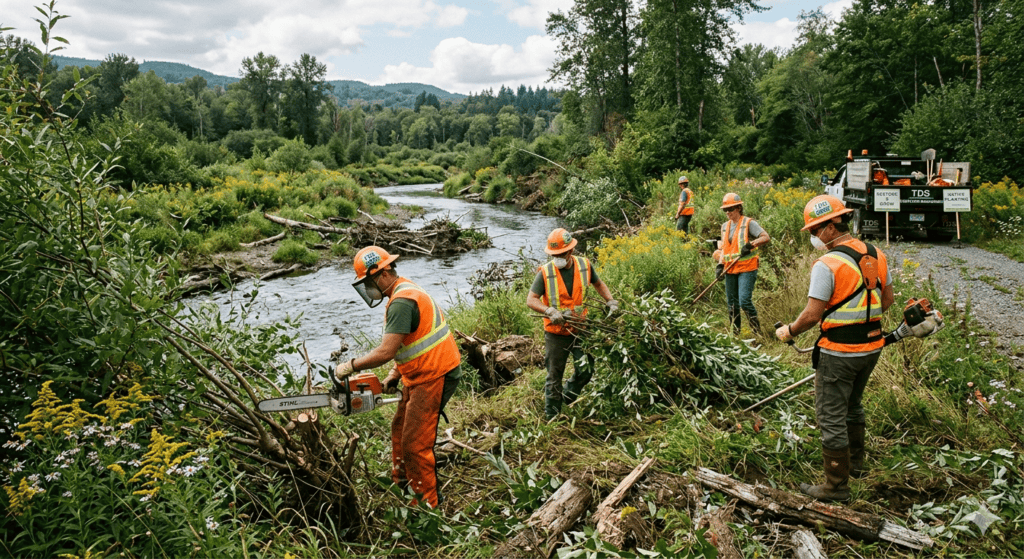
Commercial grounds maintenance is the scheduled, year-round care of the turf, planting beds, trees, shrubs, irrigation, hardscape edges, and outdoor common areas surrounding a commercial property. Different areas of a site carry different visibility and operational priorities, and plant growth, weather, and irrigation needs shift throughout the year. Leaves, weeds, moss, and overgrowth can affect drainage, sightlines, and access if left unmanaged, which is why property managers need a defined scope and clear service records rather than an informal arrangement.
This article covers what a complete program typically includes, how service changes by season, what different property types require, how contracts are structured, what affects pricing, and how to evaluate a proposal.
Property managers building a year-round maintenance plan can review TDS's commercial landscape, grounds, and vegetation services before defining the required scope.
What Does Commercial Grounds Maintenance Include?
Commercial grounds maintenance combines scheduled turf care, plant and bed maintenance, irrigation oversight, seasonal cleanups, and vegetation work within a program tailored to the property. The precise scope on any given site depends on:
- Property type and landscape design
- Plant material and turf area
- Irrigation system and site visibility
- Pedestrian and vehicle traffic
- Drainage and environmental sensitivity
- Seasonal priorities and approved budget
Turf and Lawn Care
Turf work typically includes mowing, edging, blowing, and cut-height adjustments, along with aeration, overseeding, liming, and fertilization at appropriate points in the season. Crews also watch for moss pressure, compacted soil, bare areas, and turf damage, since these conditions shape what a lawn needs next rather than a fixed routine. Mowing frequency should respond to growth and site conditions rather than following the same rigid interval every week of the year, and no program can promise a permanently green lawn regardless of irrigation availability or weather.
Garden Beds, Plants, Shrubs, and Hedges
Bed maintenance covers weed removal, mulching, soil amendment, bed edging, seasonal planting, deadheading, and ongoing plant-health observations. Shrub pruning, hedge trimming, structural pruning, sightline management, and removal of dead material also fall under this category, along with replacement recommendations where a plant is in decline. Pruning decisions should account for plant species, bloom timing, plant health, clearance needs, safety, sightlines, and the intended shape of the plant, rather than treating constant shearing as the correct approach for every shrub.
Irrigation Monitoring and Water Management
Irrigation-related tasks include seasonal startup, controller programming, zone testing, sprinkler-head inspection, leak identification, coverage checks, seasonal adjustment, and winterization where applicable. Hand watering and drip irrigation may also factor in, particularly during periods with regional watering restrictions in effect. Routine monitoring and minor adjustments are typically part of a maintenance program, while significant repairs or system redesign usually require a separately approved scope.
Cleanup, Litter, and Hardscape Edges
This part of the program covers leaf removal, storm debris, litter pickup, and blowing around parking islands, walkways, entrances, courtyards, and loading-area edges. Crews also watch for drain and catch-basin visibility, moss and organic buildup, and general site presentation. Pressure washing, sweeping, and drainage repair are not assumed to be included unless the agreement specifically states so.
How Grounds Care Changes Through the Seasons
Metro Vancouver's seasonal conditions call for a flexible service calendar rather than the same fixed list of tasks repeated every month of the year.
| Season | Main priorities | Typical work | Issues to monitor |
|---|---|---|---|
| Spring | Winter recovery and active-growth preparation | Cleanup, bed edging, turf assessment, aeration, overseeding, pruning, irrigation startup | Compaction, moss, drainage, winter plant damage |
| Summer | Growth management and water efficiency | Mowing, edging, weed control, plant care, irrigation adjustment, detailed entrance maintenance | Heat stress, water restrictions, dry areas, irrigation leaks |
| Fall | Leaf and debris management and winter preparation | Leaf removal, final mowing, bed cleanup, selective pruning, drain-area clearing, irrigation shutdown planning | Blocked catch basins, saturated soil, storm debris |
| Winter | Reduced-growth maintenance and property monitoring | Structural pruning where appropriate, debris cleanup, storm-response work, winter inspections | Broken branches, drainage issues, ice damage, salt exposure |
This table reflects a general pattern rather than a fixed schedule for each property; the right calendar still depends on the site itself.
Spring Recovery and Preparation
Spring work usually starts with clearing winter debris, assessing turf, and restoring bed edges, followed by aeration, overseeding, and soil amendments where conditions call for them. Irrigation startup, plant-replacement recommendations, and early weed control round out the season. The spring scope should reflect actual winter damage and soil conditions on the property rather than a standard checklist applied everywhere.
Summer Growth and Water Management
Summer priorities include adjusting mowing frequency for turf stress, fine-tuning irrigation, and staying within current water restrictions. Weeding, plant-health checks, and closer attention to entrances and other high-visibility zones continue through the season, along with monitoring mulch condition and watching for pests. Any watering plan should follow current regional or municipal restrictions rather than a fixed year-round schedule.
Fall Cleanup and Drainage Awareness
Fall work centres on repeated leaf removal, storm debris, and catch-basin visibility, since perimeter drains and wet leaves on walkways can create hazards if left unaddressed. Final turf work, plant and bed cleanup, and winter preparation round out this period. Leaf management may require multiple visits on properties with mature deciduous trees, since a single fall cleanup rarely keeps pace with ongoing leaf drop.
Winter Monitoring and Reduced-Growth Work
Winter tasks shift toward debris removal, storm-damage response, structural pruning where appropriate, and winter inspections. Not all pruning should happen during winter; timing still depends on the plant species and its condition. On properties that also require winter access management, grounds care often coordinates with commercial snow and ice management so both programs work from the same site priorities.
Effective commercial grounds maintenance adjusts to plant growth, weather, regional water restrictions, leaf fall, winter conditions, and the operating requirements of each property.
What Is the Difference Between Grounds Maintenance and Landscaping?
Grounds maintenance is the recurring care of an existing property, while landscaping may include design, construction, planting, grading, drainage, hardscapes, and other improvement projects. The two terms overlap in everyday conversation, but they describe different buying needs.
| Comparison point | Landscape project | Grounds-maintenance program |
|---|---|---|
| Primary purpose | Create, replace, or improve site features | Maintain existing exterior areas |
| Work pattern | Project-based | Recurring and scheduled |
| Typical scope | Planting, grading, drainage, irrigation installation, pavers, walls, site enhancements | Mowing, pruning, bed care, irrigation monitoring, cleanup, inspections |
| Pricing | Project estimate | Seasonal, annual, monthly, or per-visit agreement |
| Main buyer | Owner, developer, construction manager, or property manager | Property manager, facility manager, strata council, or operations team |
| Completion point | Ends when the approved project is completed | Continues throughout the contract term |
| Main outcome | A new or improved landscape | Consistent site condition over time |
Some properties need both, and the two often work together in sequence. A maintenance inspection might identify a failing planter, a landscape project then replaces or redesigns it, and the recurring program maintains the completed work afterward. Property managers weighing a larger improvement alongside their maintenance program can review TDS's landscape design and site-enhancement services for more detail.
How Should Property Managers Schedule Year-Round Grounds Care?
Building a workable program is easier with a structured process rather than reacting to conditions as they come up.
- Complete a full site walk. Review turf, beds, trees, shrubs, irrigation, walkways, parking islands, entrances, drainage areas, natural or sensitive areas, and both high-visibility and low-maintenance zones.
- Divide the property into maintenance zones. Zones might include main entrances, tenant-facing areas, parking areas, courtyards, service areas, perimeter planting, natural areas, slopes, and drainage corridors, since different zones often need different frequencies and standards.
- Build a seasonal task calendar. Define recurring tasks, seasonal tasks, inspection periods, irrigation dates, cleanup cycles, enhancement planning, and winter-transition work.
- Define service frequencies without assuming one universal schedule. Service may be weekly, biweekly, monthly, seasonal, condition-based, on request, or triggered by weather or plant growth.
- Establish reporting and approvals. Define the property contact, contractor contact, service logs, photographs, deficiency reports, recommendations, approval limits, and additional-work authorization.
- Review the program during the year. Schedules may need adjustment because of weather, plant growth, water restrictions, construction, tenant needs, site damage, budget changes, or new property priorities.
Property managers ready to formalize this process can request a site-specific grounds maintenance plan built around their property's actual conditions.
What Do Different Commercial Properties Need?
Grounds-maintenance priorities should follow how a property is actually used rather than a single standard applied to every site.
Strata and Multi-Unit Properties
Strata sites typically need attention paid to shared entrances, resident walkways, common gardens, amenity areas, and parkade entrances, along with irrigation, council communication, budget approvals, and resident-facing presentation. A clear scope of work can reduce disputes about whether a specific task is included in the agreement, which matters when a council is answering to residents. TDS's strata landscaping maintenance services address this kind of shared-property coordination directly.
Office Parks and Corporate Campuses
These properties tend to prioritize main entrances, signage visibility, parking islands, courtyards, and tenant access, along with litter control and clear sightlines. Service usually needs to happen with minimal disruption during business hours, and consistent standards across multiple buildings on one campus matter to tenants and ownership alike.
Retail and Mixed-Use Properties
High pedestrian visibility, storefront approaches, drive-thrus, and parking areas are usually the priority here, along with seasonal displays and managing litter pressure from customer traffic. Safe sightlines and service timing outside busy periods help these properties maintain a presentable appearance without disrupting customers.
Industrial and Warehouse Sites
Larger, lower-detail sites often need broad-area mowing, weed control, and line-of-sight clearing across large perimeters, along with attention to loading areas, drainage corridors, equipment access, and fire and emergency access. The scale of vegetation work here is usually larger and less detailed than at a retail or office property.
Municipal, Institutional, and Public-Sector Sites
These sites often involve public access, contract reporting, safety planning, and larger grounds that may include trails, native planting, and natural areas. Environmental requirements and tender or procurement processes often shape the service standard in ways that differ from a typical commercial contract. Vegetation and natural-area work on these sites connects closely with TDS's environmental services for sensitive or regulated areas.
How Should Irrigation, Weeds, and Plant Health Be Managed?
These issues are best handled through monitoring and site-specific decisions rather than automatic, blanket treatment.
Irrigation and Regional Water Restrictions
Property managers and contractors should confirm the current watering stage and any non-residential restrictions before adjusting controller programming, permitted watering times, or drip and hand-watering routines. New plantings, leak identification, soil moisture, and plant stress all factor into how irrigation is managed day to day. Restrictions can change during the season, so both parties should check current requirements against the Metro Vancouver Drinking Water Conservation Plan rather than assume one stage applies all year, since individual municipalities administer and enforce their own regional restrictions.
Integrated Pest Management
An integrated approach typically includes correct pest identification, monitoring, prevention, appropriate plant selection, soil and irrigation management, physical and cultural controls, and treatment only when it is justified, supported by record keeping. This is different from routine chemical application, and not every contractor is set up to apply commercial pesticides. Businesses and multi-residence property managers applying pesticides must follow the relevant British Columbia landscape pest management guidance along with applicable municipal bylaws.
Invasive Plants and Vegetation
Invasive-species work involves identification, monitoring, containment, and appropriate removal or treatment, along with equipment cleanliness, care around soil disturbance, and proper disposal. Natural-area considerations and reporting of significant findings matter here, particularly on sites bordering sensitive habitat.
Tree and Shrub Work
Routine shrub pruning and hedge maintenance differ from small-tree care, and both differ again from arborist assessment, hazardous tree work, or removal. Some private-property tree removals require review under City of Vancouver tree removal permit requirements, though tree bylaws and permit thresholds vary by municipality and should be confirmed locally before any removal work begins. Routine grounds crews should not be expected to complete specialist arboricultural work outside their qualifications or approved scope.
What Should a Grounds-Maintenance Contract Include?
A commercial grounds maintenance agreement should define the property areas, recurring tasks, service frequencies, seasonal work, reporting process, exclusions, and approval procedure for additional services. Without these terms in writing, it becomes difficult to hold either party accountable once the season is underway.
A complete agreement typically covers the site map, maintenance zones, scope of work, service frequencies, seasonal calendar, turf tasks, bed tasks, pruning, irrigation, cleanup, litter, vegetation management, inspection requirements, reporting, contacts on both sides, a quality-review process, additional-work authorization, materials, disposal, insurance, WorkSafeBC status, subcontractor disclosure, contract term, renewal, cancellation, price adjustments, and exclusions.
Recurring Work Versus Additional Work
The agreement should clearly separate routine service from work that requires separate approval. Common examples of additional work include:
- Plant replacement and mulch beyond the base allowance
- Irrigation or drainage repairs
- Tree removal or arborist work
- Storm cleanup and landscape enhancements
- Pressure washing and invasive-species treatment
- Large-scale vegetation clearing
- Snow and ice management
Service Standards and Reporting
Useful reporting typically includes the visit date, areas serviced, tasks completed, photographs, deficiencies, irrigation issues, plant-health concerns, drainage concerns, recommended work, client instructions, and follow-up dates. Documentation supports accountability and communication, but it is not proof that every site issue has been fully resolved.
Insurance and WorkSafeBC Status
Property managers should confirm current commercial liability insurance, a certificate of insurance, WorkSafeBC registration, a WorkSafeBC clearance letter where applicable, and how responsibility for any subcontractors is handled. This article does not recommend a universal insurance limit, since appropriate coverage depends on the property. TDS's safety and project-planning practices reflect the documentation standard property managers should expect from a commercial-scale contractor.
How Much Does Commercial Grounds Maintenance Cost in Metro Vancouver?
Cost depends on total property area, the amount of turf, the number and size of planting beds, the tree and shrub inventory, the irrigation system, service frequency, property type, number of entrances, parking islands, litter pressure, leaf volume, terrain, slopes, site access, equipment requirements, seasonal cleanup, reporting, disposal, watering requirements, vegetation-management needs, additional services, and contract length.
Square footage alone rarely tells the full story. An open industrial perimeter may only need mechanized mowing, while a smaller office property with detailed beds, courtyards, entrances, and irrigation zones can require considerably more labour per square metre. A mature strata site may need repeated leaf cleanup and detailed pruning, and a natural area may call for environmental protocols and specialized vegetation work. An accurate price typically requires a site walk, a property map, an asset review, a defined service standard, an agreed frequency, and a clear contract scope.
Property managers ready to move forward can request a commercial grounds maintenance assessment based on their actual property conditions.
How to Compare Commercial Grounds Contractors
Commercial grounds maintenance proposals should be compared using the same property map, seasonal requirements, service frequencies, and reporting expectations rather than total price alone. Two bids built on different assumptions about scope are not really comparable, no matter how close the numbers look.
Worth evaluating: commercial experience, relevant property types served, scope clarity, crew capacity, equipment, whether work is completed in-house or subcontracted, horticultural knowledge, irrigation capability, pest-management qualifications where relevant, vegetation-management capability, WorkSafeBC status, insurance, reporting, quality review, communication, winter capability, ability to address related property issues, references, and contract exclusions.
Questions to Ask Before Hiring
- Which services and areas are included?
- How are service frequencies determined, and how does the schedule change by season?
- Who supervises the account, and what reports are provided?
- How are irrigation problems and plant-health or pest concerns reported?
- Which services require separate authorization?
- Is the work completed in-house?
- Are pesticide applications performed by appropriately qualified personnel?
- Can the contractor provide current insurance documentation and WorkSafeBC clearance where applicable?
- How are missed or incomplete tasks handled?
- Can the provider support winter services, and how are contract changes approved?
Warning Signs
A few patterns tend to signal a weaker proposal worth questioning further:
- A vague scope with no site walk
- No defined service frequencies or seasonal calendar
- No stated irrigation responsibilities or reporting process
- No insurance evidence or WorkSafeBC information
- Unclear subcontractor use
- The same generic program applied regardless of property conditions
- A substantially lower bid with no explanation for the difference
- Chemical-treatment claims made without qualification or regulatory context
Property managers can also review TDS's in-house team and equipment as one example of how a commercial provider structures its capacity.
Coordinating Grounds Care With Other Property Services
Recurring grounds inspections often surface issues beyond the landscape itself, including drainage problems, blocked catch basins, damaged curbs, uneven pavers, asphalt deterioration, irrigation failures, erosion, damaged planters, failing retaining walls, vegetation affecting access, and winter surface damage. Grounds crews can identify and report these conditions, but repair work should be separately assessed and approved rather than folded into routine maintenance.
There is an operational advantage to coordinating grounds maintenance with related property work. TDS's commercial site repairs and waterproofing services can address drainage and surface issues that a grounds crew flags during a routine visit.
A single provider is not automatically the right choice for each property, but where it fits, coordinating landscape care with TDS's full range of commercial property services can reduce the gaps that often appear between separate contractors handling different parts of the same site.
Building a Year-Round Grounds Plan for Your Property
Effective commercial grounds maintenance depends on an accurate site assessment, defined service zones, seasonal scheduling, appropriate service frequencies, irrigation management, turf and plant care, cleanup, vegetation management, reporting, clear contract terms, and coordination with related property needs.
The next practical step is to review the property, define the desired maintenance standard, and build an itemized scope rather than accepting a generic package. Property managers ready to plan ahead of the growing season can discuss a year-round grounds maintenance plan with TDS.
Frequently Asked Questions
What is commercial grounds maintenance?
Commercial grounds maintenance is the scheduled care of turf, planting beds, trees, shrubs, irrigation, cleanup areas, and other exterior property features. It is recurring work carried out under a defined program rather than a one-time service.
What services are included in commercial grounds maintenance?
Common services include mowing, edging, pruning, bed care, weed management, seasonal cleanups, irrigation monitoring, plant-health observations, and reporting. The exact scope depends on what the specific contract defines for that property.
How often should commercial properties schedule grounds maintenance?
Frequency depends on plant growth, property use, the desired maintenance standard, the season, and the specific zone within the property. There is no single weekly or biweekly schedule that applies to every site.
Is grounds maintenance the same as landscaping?
Grounds maintenance is the recurring care of an existing property, while landscaping may include design, installation, construction, drainage, planting, or major site improvements. The two are related but address different needs.
How much does commercial grounds maintenance cost in Metro Vancouver?
Cost depends on property size, landscape complexity, service frequency, irrigation, seasonal work, vegetation management, reporting, and any additional services required. A site-specific assessment is the most reliable way to arrive at an accurate figure.
Can one contractor provide grounds maintenance and snow removal?
Some commercial contractors offer both under coordinated year-round programs, which can simplify communication across seasons. Property managers should still confirm the exact winter scope, triggers, reporting, equipment, and pricing as a separate part of the agreement.