
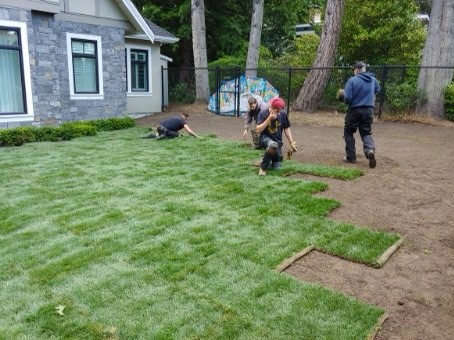
Commercial lawn care is the scheduled maintenance and management of turf surrounding office buildings, strata developments, retail properties, institutions, municipal sites, and other commercial facilities. A complete turf program may include mowing, edging, turf-health monitoring, aeration, overseeding, fertilization, weed and moss management, irrigation checks, and seasonal repair work, depending on what the property actually needs.
Metro Vancouver's climate adds its own variables to this picture. Turf can grow through much of the year, wet conditions can increase moss and compaction concerns, summer watering restrictions shape irrigation schedules, and shade, drainage, and foot traffic vary considerably from one property to the next.
This article covers what a professional turf program typically includes, how service changes through the seasons, how larger and strata properties are managed, what a contract should define, what affects pricing, and how to compare providers.
Property managers planning a structured turf program can review TDS's commercial landscape, grounds, and vegetation services before defining the required scope.
What Does Commercial Lawn Care Include?
Commercial lawn care combines scheduled mowing, turf-health work, irrigation monitoring, weed management, seasonal services, and reporting within a program tailored to the property. The exact scope on any given site depends on turf area, grass condition, soil, drainage, shade, irrigation, foot and vehicle traffic, property type, the desired maintenance standard, seasonal conditions, and the approved budget.
Commercial Mowing, Edging, and Blowing
Mowing work covers cutting height, frequency, edging, trimming around obstacles, clipping management, and blowing walkways and curbs, along with equipment selection suited to the site and any wet-ground conditions that affect timing. Mowing should be adjusted to the actual growth rate and turf condition rather than following one fixed weekly schedule for each property. Removing excessive grass height in a single cut is generally avoided, since it stresses turf rather than restoring it.
Aeration, Overseeding, and Soil Improvement
Core aeration, overseeding, liming, fertilization, soil amendment, and topdressing each serve a distinct purpose, and they should not be treated as interchangeable steps. These tasks address compaction, thin turf, bare areas, root development, soil contact, and establishment watering, with timing that reflects the season rather than a fixed date on a calendar. Aeration or overseeding will not automatically restore severely damaged turf on their own.
Weed, Moss, and Turf-Health Monitoring
This part of the program covers weed identification, moss, turf density, bare patches, disease symptoms, and pest damage, along with the soil conditions, shade, drainage, mowing practices, and irrigation problems that often sit behind them. Weed or moss pressure frequently signals an underlying site condition rather than simply a need for treatment. Routine pesticide use should not be assumed as part of this work.
Irrigation Monitoring
Irrigation-related tasks include controller settings, sprinkler zones, head alignment, coverage, leaks, runoff, and watering duration, adjusted for seasonal changes, current water restrictions, new-seed establishment, and turf stress. Monitoring and minor adjustments are typically part of ongoing lawn care, while major irrigation repair or system redesign usually calls for a separate assessment and approved scope. TDS's commercial turf and grounds maintenance work incorporates this kind of monitoring as part of a broader program.
What Is Turf Management, and How Is It Different From Mowing?
Mowing controls turf height and appearance. Turf management addresses the broader conditions that influence grass density, root development, soil health, moisture, weeds, moss, wear, and seasonal performance, which makes it a larger undertaking than cutting grass on a schedule.
Turf management can involve assessing soil compaction, adjusting mowing height, identifying worn areas, monitoring irrigation, aerating, overseeding, liming, fertilizing, reviewing drainage, managing weeds and moss, and recommending repair or replacement where warranted.
| Comparison point | Mowing service | Turf-management program |
|---|---|---|
| Main purpose | Control grass height and maintain a tidy appearance | Maintain turf condition across changing site and seasonal conditions |
| Typical work | Mowing, trimming, edging, and blowing | Mowing plus soil, irrigation, compaction, weed, moss, and repair planning |
| Frequency | Based mainly on grass growth | Includes recurring work and condition-based seasonal tasks |
| Soil management | Usually not included | May include aeration, liming, fertilization, and soil recommendations |
| Thin or damaged turf | May only be mowed | Assessed for overseeding, drainage, irrigation, or replacement needs |
| Reporting | Basic visit confirmation | May include turf observations, deficiencies, and recommendations |
| Best fit | Properties needing basic appearance maintenance | Properties requiring planned, long-term turf care |
Not all properties need an intensive turf program. The appropriate service level should reflect site use, turf visibility, existing condition, maintenance objectives, and budget.
How Is Turf Managed on Large Commercial and Strata Properties?
Large properties are typically divided into maintenance zones rather than treated as one uniform lawn. Common zones include main entrances, courtyards, amenity areas, building frontages, parking islands, roadside turf, perimeter areas, slopes, drainage corridors, low-visibility areas, high-traffic areas, pet-use areas, and utility areas.
High-Visibility Turf
Main entrances, signage areas, tenant-facing courtyards, sales or leasing areas, and customer approaches tend to need more frequent detail work, edging, repair, and inspection than areas further from public view.
High-Traffic and Worn Areas
Informal pedestrian routes, loading areas, event spaces, common areas, dog-use areas, and vehicle encroachment often lead to compaction, mud, and bare turf over time. Repeated damage in these zones may call for traffic redirection, soil improvement, overseeding, sod replacement, drainage work, or a change in surface material altogether. Repeated overseeding rarely solves the problem when the underlying use pattern stays the same.
Low-Visibility and Broad-Area Turf
Perimeters, industrial edges, roadside areas, utility zones, slopes, and large open sections are usually maintained through broader mowing and vegetation-management methods rather than detailed ornamental care, since the standard expected here differs from a main entrance or courtyard.
Strata and Multi-Unit Properties
Strata properties bring their own considerations, including shared lawns, resident expectations, pet use, amenity areas, parkade entrances, irrigation, council reporting, budget approvals, complaint tracking, and seasonal work. TDS's strata landscaping maintenance services address this kind of shared-property coordination directly.
Effective commercial lawn care uses different maintenance zones, equipment, and service frequencies rather than treating every turf area on a large property the same.
How Often Should Commercial Turf Be Mowed and Maintained?
There is no universal mowing or treatment calendar that applies across properties. Frequency depends on grass growth, season, rainfall, irrigation, soil moisture, turf type, shade, desired appearance, property use, water restrictions, mowing height, and equipment access.
| Season | Main turf priorities | Typical activities | Conditions to monitor |
|---|---|---|---|
| Spring | Recovery and active growth | Mowing adjustments, turf assessment, aeration where appropriate, overseeding, soil review | Moss, compaction, winter damage, saturated soil |
| Summer | Growth control and moisture management | Mowing, edging, irrigation adjustment, weed monitoring, repair of worn areas | Heat stress, drought, watering restrictions, uneven irrigation |
| Fall | Turf repair and winter preparation | Continued mowing, aeration or overseeding where appropriate, leaf management, drainage review | Leaf cover, saturated soil, thinning turf |
| Winter | Reduced-growth monitoring | Mowing only when needed, debris cleanup, drainage observation, storm-damage review | Waterlogging, frost damage, poor drainage, turf wear |
This table describes a general pattern rather than a fixed service frequency for any specific property.
Mowing Frequency
Mowing tends to be more frequent during periods of active growth and less frequent when growth slows. Crews generally avoid mowing saturated turf, adjust to seasonal growth, aim for a consistent appearance, watch for excessive clipping accumulation, and avoid scalping the lawn. Not all commercial lawns require weekly mowing; the right interval depends on the site and season.
Mowing Height
Mowing height should account for turf type, weather, shade, irrigation, stress, intended use, and seasonal growth. There is no single universal height that suits all turf; the appropriate cut depends on the grass type and conditions at that specific property.
Aeration and Overseeding Timing
Timing for aeration and overseeding should reflect soil moisture, turf growth, heat, irrigation availability, seed establishment needs, site use, and expected foot traffic. Aeration and overseeding twice a year is not a default requirement for every commercial property; the right frequency depends on the turf's actual condition.
Who Manages Irrigation and Turf Health for Commercial Properties?
Responsibility for irrigation should be spelled out in the maintenance agreement rather than assumed. Depending on the property, the contractor may monitor and adjust the system, property staff may control irrigation directly, a separate irrigation specialist may handle repairs, the grounds contractor may report problems for approval, or the property manager may authorize seasonal changes.
Irrigation Checks
Routine checks typically cover controller settings, start and run times, zone operation, head alignment, broken heads, leaks, overspray, dry zones, pooling, runoff, and seasonal shutdown or winterization where applicable.
Metro Vancouver Water Restrictions
Watering requirements can change through regional restriction stages, so property managers should confirm the current regional stage, municipal enforcement, non-residential watering days, permitted times, rules for new turf, rules for hand watering or drip irrigation, and any exempt water sources before scheduling irrigation. Current requirements should be checked against the Metro Vancouver Drinking Water Conservation Plan rather than assumed from a prior season, since the plan applies to Greater Vancouver Water District member jurisdictions and local enforcement can vary.
Turf Problems That May Be Irrigation or Drainage Problems
Persistent wet areas, yellow or dry zones, runoff, erosion, moss, shallow roots, standing water, broken irrigation, poor grading, compacted soil, and blocked drainage can all point to an irrigation or drainage issue rather than a straightforward turf problem. Repairing drainage, grading, or irrigation infrastructure typically requires a separate scope, and TDS's commercial surface and drainage repair services can address these issues once a grounds crew identifies them.
Properties dealing with persistent pooling or irrigation trouble can discuss a site-specific turf and irrigation plan with TDS.
How Should Weeds, Moss, and Turf Pests Be Managed?
An integrated pest management approach typically follows a consistent process:
- Correct identification
- Monitoring
- Understanding the site condition
- Preventive maintenance
- Cultural or physical controls
- Treatment only when justified
- Documentation
- Compliance with provincial requirements and local bylaws
Weed Management
Weed pressure often relates to turf density, bare soil, mowing practices, soil fertility, irrigation, compaction, and seed spread. Management typically combines manual removal and prevention with treatment where it is permitted and appropriate; not every broadleaf plant requires chemical control.
Moss Management
Moss is commonly associated with shade, moisture, poor drainage, compaction, thin turf, soil conditions, and low turf vigour. Removing moss without addressing these underlying site conditions often leads to recurrence within a season or two.
Pest and Disease Observations
Irregular turf damage, discolouration, root damage, animal activity, fungal symptoms, seasonal stress, and irrigation problems can all resemble each other on the surface. A turf disease should not be diagnosed from appearance alone; proper identification should come before any treatment decision.
Pesticide Rules
Businesses applying pesticides must follow provincial requirements, and municipal bylaws may add further restrictions on top of that. Product labels must be followed, cosmetic pesticide use may be restricted depending on the municipality, and treatment should never be described as routine or automatic. The British Columbia landscape pest management guidance outlines this integrated approach, and properties within Vancouver specifically fall under the city's own pesticide restrictions for lawns and gardens, which do not automatically apply to other Metro Vancouver municipalities.
What Should a Commercial Lawn-Care Contract Include?
A commercial lawn care agreement should define the turf areas, services, frequencies, seasonal tasks, materials, reporting process, exclusions, and approval procedure for additional work. Without these terms written down, it is difficult for either party to know what the season's service is actually supposed to look like.
A complete agreement typically covers the property map, turf zones, mowing areas and frequency process, edging, blowing, aeration, overseeding, liming, fertilization, weed and moss management, irrigation responsibilities, seasonal cleanup, leaf removal, clipping disposal, turf repair, materials, reporting, contacts on both sides, additional-work approval, insurance, WorkSafeBC, subcontractor disclosure, contract term, renewal, cancellation, price adjustment, and exclusions.
Recurring Work Versus Additional Work
Additional work generally requires separate written approval before it proceeds. Common examples include:
- Sod replacement and large-scale turf renovation
- Drainage or irrigation repair
- Regrading or soil replacement
- Tree work or new planting
- Pest treatment or invasive-species treatment
- Storm cleanup and landscape construction
- Snow and ice management
Service Reporting
Useful reporting typically covers the date of visit, areas serviced, work completed, turf observations, irrigation issues, weed or moss concerns, photographs, recommendations, client instructions, and follow-up requirements. Reporting supports communication and accountability, but it does not prove that every service standard has been met unless the contract defines that standard explicitly.
Insurance and WorkSafeBC
Property managers should verify current commercial liability insurance, a certificate of insurance, WorkSafeBC registration, and a WorkSafeBC clearance letter where applicable, along with how responsibility for any subcontractors is handled. This article does not recommend a universal liability-insurance limit, since appropriate coverage depends on the property. TDS's safety and project-planning practices reflect the documentation standard worth expecting from a commercial-scale provider.
How Much Does Commercial Lawn Care Cost in Metro Vancouver?
Cost depends on total turf area, site layout, mowing frequency, edging requirements, number of obstacles, slopes, equipment access, soil condition, irrigation, aeration, overseeding, fertilization, weed and moss management, seasonal cleanup, leaf volume, turf repair, reporting, disposal, contract length, multi-site requirements, and any additional services.
Square footage alone rarely tells the full story. A large open lawn may be serviced efficiently with commercial mowing equipment, while a smaller property with slopes, islands, trees, signs, narrow areas, and extensive edging can require considerably more labour per square metre. A high-visibility office property may need more detail work than an industrial perimeter, and a poorly drained strata lawn may require additional observation and repair planning. An accurate quote typically requires a site walk, a turf-area map, a condition assessment, the desired maintenance standard, a seasonal scope, an irrigation review, and a service-frequency plan.
Property managers ready to move forward can request a commercial lawn care assessment based on their property's actual conditions.
How to Compare Commercial Lawn-Care Providers
Commercial lawn care proposals should be compared using the same property map, turf standard, service frequency, and requested scope rather than total price alone. Two quotes built on different assumptions are difficult to judge fairly side by side.
Worth evaluating: commercial property experience, turf-management knowledge, scope clarity, crew capacity, equipment, whether work is completed in-house or subcontracted, irrigation capability, weed and pest-management qualifications, WorkSafeBC status, insurance, reporting, communication, seasonal planning, winter capability, references, contract exclusions, and the additional-work process.
Questions to Ask
- Which turf areas are included?
- How is mowing frequency determined, and how is mowing height selected?
- Are edging and blowing included?
- Are aeration and overseeding included?
- Who manages irrigation, and how are leaks and coverage problems reported?
- How are moss and weeds assessed?
- Are pesticide applications part of the scope, and what qualifications apply to that work?
- What reporting is provided?
- Is the work completed in-house, and what equipment is assigned to the site?
- Can the contractor provide insurance documentation and WorkSafeBC clearance?
- What work requires separate approval?
- Can the provider also coordinate snow and ice service, and how are complaints or missed tasks addressed?
Warning Signs
A few patterns are worth questioning further before signing:
- No site walk or turf-area map
- The same schedule applied regardless of property conditions
- No stated irrigation responsibility or reporting process
- No insurance evidence or WorkSafeBC information
- Routine pesticide claims with no regulatory context
- Guaranteed turf recovery
- An extremely low price with no explanation of scope
- Vague additional charges
Property managers can also review TDS's in-house crews and equipment as one example of how a commercial provider structures its capacity.
Can Lawn Care and Snow Removal Be Managed Under One Property Program?
Some commercial providers coordinate lawn and turf maintenance, landscape maintenance, vegetation management, seasonal cleanups, site repairs, and snow and ice management under one program. Potential operational benefits include a single property contact, shared site knowledge, coordinated seasonal transitions, fewer gaps between fall cleanup and winter service, clearer property maps, consistent reporting, and easier identification of surface or drainage issues across both seasons.
Consolidating services does not automatically cost less, and the property manager should still confirm separate scopes for turf care, snow triggers, de-icing, equipment, reporting, pricing, and contract exclusions. TDS's commercial snow and ice management operates as its own defined scope alongside landscape work.
Where it fits, coordinating turf care with TDS's full range of commercial property services can simplify communication across the year without blurring the separate terms each service is built on.
Building a Commercial Turf Program for Your Property
Effective commercial lawn care depends on a proper site assessment, defined turf zones, growth-based mowing, appropriate mowing height, soil and compaction observations, irrigation monitoring, aeration and overseeding where justified, weed and moss management, seasonal scheduling, clear reporting, and defined contract terms.
The next step is to assess the site, define the required appearance and turf standard, and prepare an itemized service scope rather than defaulting to a generic package. Property managers ready to plan ahead of the growing season can discuss a commercial turf management plan with TDS.
Frequently Asked Questions
What is commercial lawn care?
Commercial lawn care is the scheduled maintenance and management of turf around commercial, strata, municipal, and institutional properties. It covers mowing along with the broader turf-health work needed to keep grass performing well across the season.
What is included in a commercial lawn-care program?
A program can include mowing, edging, turf assessment, aeration, overseeding, weed and moss management, irrigation monitoring, seasonal work, and reporting. The signed contract determines the exact scope for a given property.
How often should a commercial lawn be mowed?
Mowing frequency depends on growth, season, irrigation, weather, turf condition, and the required maintenance standard. There is no single schedule that applies across all properties or every time of year.
What is the difference between mowing and turf management?
Mowing controls grass height and appearance, while turf management considers soil, irrigation, compaction, weeds, moss, fertility, repair needs, and seasonal performance. Turf management is the broader, ongoing program that mowing sits inside.
How much does commercial lawn care cost in Vancouver?
Cost depends on turf area, layout, mowing frequency, edging, irrigation, soil condition, seasonal services, reporting, and any additional work required. A site-specific assessment gives the most accurate figure for a particular property.
Can a commercial lawn-care company also provide snow removal?
Some commercial property-services providers offer both under one coordinated program. The lawn and snow scopes, triggers, equipment, reporting, and pricing should still be defined as separate parts of the agreement.