
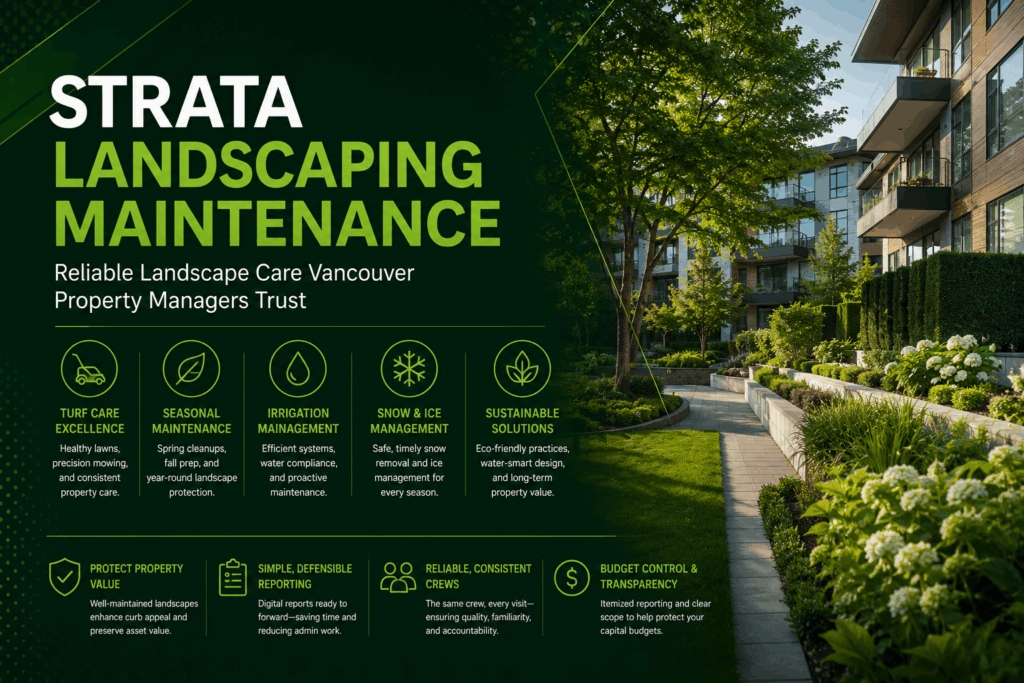
TDS delivers high-performance strata landscaping maintenance Vancouver property managers rely on to eliminate owner complaints and protect capital budgets. Our comprehensive single-contract service manages recurring turf care, seasonal cleanups, strict water-restriction irrigation compliance, and rapid winter snow operations across the Lower Mainland. We eliminate your administrative workload by providing pre-formatted, council-ready digital reports you can forward instantly without rewriting.
Request a strata landscaping maintenance quote
Strata Landscaping Maintenance for Vancouver Properties
Strata landscaping fails on visibility and responsiveness, not technical competence. Residents interact with common areas daily; a missed hedge trim or a front-entrance weed quickly escalates into a council complaint or an AGM agenda item. Most disputes happen because councils inherit legacy contracts where the written scope does not match current resident expectations. When a vendor delivers only what is written, the property manager fields the fallout with zero written data to defend the account.
The TDS Strata Workflow Advantage
TDS designs commercial landscaping maintenance contracts for strata developments to protect the property manager’s time. Our crews identify and report out-of-scope issues before residents spot them. We deliver precise digital logs and incident reports formatted to be forwarded directly to council without rewriting, turning landscape management into a seamless, defensible file.
Integrated Strata Services
We consolidate your exterior operations into a single, itemized agreement to eliminate service gaps:
- Strata Landscaping Services Vancouver: Comprehensive turf care, precision pruning, and systematic strata garden maintenance in Vancouver tailored to high-visibility multi-unit properties.
- Seasonal Maintenance for Multi-Unit Residential Developments: Strategic spring and fall cleanups, structural pruning, and proactive bed care to control weed pressure before it spikes.
- Irrigation Management for Strata Councils: Active system start-ups, monthly zone testing, repairs, and winterization to prevent water waste and property damage.
- Snow and Ice Management for Strata Properties: Zero-threshold winter monitoring and prioritized clearance of walkways, parkade ramps, and building entrances.
- Sustainable Landscaping Solutions for Strata Communities: Certified carbon-neutral operations, water-efficient irrigation design, and native planting plans that integrate into your BC Section 94 depreciation reports.
Reliable Multi-Unit Property Maintenance
Whether managing a townhouse complex or a high-density tower, choose the trusted choice for multi-unit residential landscaping in Vancouver. TDS eliminates contract ambiguity, simplifies your administration, and protects your property’s long-term curb appeal.
Request a Strata Maintenance Quote
Our Strata Landscaping Maintenance Services
Standard strata turf maintenance often fails because contractors follow a rigid, calendar-based contract template instead of adapting to actual turf biology. The fescue-and-ryegrass blends dominant across Lower Mainland strata lawns grow aggressively during wet spring months, go dormant during summer dry spells, and suffer severe heat stress through August if cut heights are not adjusted to protect the root system.
TDS eliminates generic mowing schedules, managing your turf through three distinct seasonal adjustments to protect lawn health and control contract costs.
Seasonal Turf Adjustments
- Mowing Frequency: We mow weekly from late April through September, and biweekly during the shoulder seasons of March, early April, and October. Rather than forcing crews to mow dormant, brown grass in August just to fulfill a contract line item, we dynamically adjust frequency based on actual growth, reallocating that crew time to detail garden beds.
- Cut Height Management: We maintain a sharp 2.5 to 3-inch cut height during rapid spring growth. In mid-summer, we raise the deck to 3 to 3.5 inches to shade the soil, retain moisture, and protect the root system from drought. For the final cuts of the year, we lower the deck back to 2.5 inches to prevent long blades from matting and trapping overwintering turf diseases like snow mold.
- Clippings and Debris Control: We mulch and return finely chopped grass clippings to the lawn during the active growing season to naturally recycle nutrients. During the final fall cuts, we switch to bagging to manage heavy leaf loads. Our crews strictly avoid side-discharge mowing near multi-unit buildings to prevent throwing debris and grass stains onto your garden beds, parked vehicles, and walkways.
Soil Amendments and Preventive Care
Core aeration, overseeding, and agricultural liming are executed precisely in the fall. This timing capitalizes on warm soil temperatures for rapid seed germination and leverages returning autumn rains to establish strong roots before winter.
For shaded strata lawns sitting beneath mature tree canopies, we manage moss on a proactive, annual cycle. Treating moss reactively in the spring leaves bare, muddy patches that cannot recover before the mowing season begins, creating prime territory for weed infestations. By treating soil acidity and moss systematically in the fall, the lawn naturally fills in by spring.
The Value of Route Consistency
The exact same crew that mowed your property last week is the crew mowing it this week. Route consistency builds deep site familiarity. A crew’s thirtieth visit to your property runs significantly faster and cleaner than their first because they know every hidden irrigation head, tight corner, and resident preference. TDS passes this operational efficiency directly to the strata corporation through long-term pricing stability across budget renewal cycles, ensuring your service standard never degrades.
What Landscaping Services Do Strata Properties Need?
| Strata landscaping need | What it includes |
| Lawn and turf care | Mowing, edging, blowing, seasonal cycle adjustment, aeration, overseeding, liming, moss treatment |
| Garden maintenance | Weeding, mulch refresh, seasonal planting, plant health monitoring, soil amendment, debris removal |
| Shrub and hedge care | Bloom-time pruning on flowering shrubs, late-winter structural pruning, sightline pruning at entrances and walkways |
| Irrigation support | Startup, mid-season check, shutdown, controller programming, leak identification, sprinkling restriction compliance |
| Seasonal cleanup | Spring winter-recovery cleanup, multi-visit fall leaf removal, storm debris response, winter readiness |
| Snow and ice management | Walkways, entrances, parking areas, ramps, anti-icing where contracts allow, priority sequencing for resident-facing access |
| Sustainable landscaping | Carbon neutral operations, native and drought-tolerant planting, water-conscious irrigation, depreciation report documentation |
Strata Landscaping Maintenance Contracts in Vancouver
To eliminate mid-year scope disputes and protect your capital budget, the strongest commercial landscaping maintenance contracts for strata developments make these six elements explicit before signing:
The Six Structural Contract Essentials
- Itemized Service Frequency: This includes the mowing cycle (weekly April–September, biweekly shoulder months), bed maintenance intervals (biweekly in summer, monthly in winter), pruning windows (based on bloom timing and structural winter needs), and a fixed irrigation management for strata councils schedule (April startup, mid-season audit, October winterization).
- Seasonal Scope Boundaries: Contracts must explicitly define spring cleanup deliverables and dictate the exact fall cleanup visit count. For properties with mature trees, this requires four to six dedicated visits during peak leaf-drop weeks, not a single end-of-season pass. It must also define where standard maintenance ends and emergency storm response begins.
- Snow and Ice Triggers: The contract must state precise operational thresholds. The standard for snow and ice management for strata properties is a 2 cm accumulation trigger on hard surfaces; a 5 cm trigger leaves the property exposed to severe slip-and-fall liabilities. It must also lock in priority sequencing (resident walkways and parkade ramps cleared first) and outline pre-treatment anti-icing protocols.
- Pre-Approved Out-of-Scope Rates: Hourly rates and material markups for plant replacements, drainage corrections, hardscape repairs, and storm cleanups must be posted in advance. Establishing these fixed rates protects councils from unexpected change orders that consume valuable meeting time once a project is already underway.
- Standardized Reporting Cadence: Demand digital visit logs, incident reports, and seasonal summaries delivered in a clear, executive format. Property managers should be able to hand these documents directly to the council or attach them to AGM packages without re-formatting them.
- Clear Renewal and Escalation Terms: Contracts should define the exact renewal trigger. Vendors that utilize digital job-cost tracking can base next year’s pricing on historical site data rather than guesswork, giving councils a clear, math-based argument for long-term contractor continuity.
Two Procurement Realities for Strata Councils
When managing seasonal maintenance for multi-unit residential developments, councils must align their procurement with two operational facts:
- Bonding and Insurance Thresholds: Any contract exceeding $50,000 annually warrants comprehensive contractor bonding alongside standard multi-million-dollar commercial liability and active WorkSafeBC coverage. Verifying these thresholds prevents massive financial exposure for the strata corporation if an on-site incident occurs.
- The Procurement Timeline: Strata RFPs for contracts starting in April must be issued the previous October or November. This provides six weeks for proposals, four weeks for council review, four weeks for contractor selection, and four weeks for mobilization. Waiting until February forces rushed decisions that compromise a full year of service quality.
Seasonal Strata Landscaping in Vancouver
Spring Maintenance
Spring maintenance runs from late February through April and requires two to four cleanup visits depending on your winter debris load. The primary focus is winter recovery. Crews clear blown-in debris from garden beds, recut turf edges, and complete an initial turf grooming pass before the active mowing season begins.
We provide a written winter damage assessment by early March. This timeline ensures the property manager can insert exact plant replacement quotes directly into council packages for upcoming spring Annual General Meetings.
Mulch is applied at a two to three-inch depth once coastal soil temperatures hold above ten degrees Celsius in mid-March. Pruning schedules follow exact plant bloom timing rather than arbitrary calendar dates. The irrigation startup process includes a complete system walkthrough, controller programming optimized for current conditions, and comprehensive leak identification before summer usage increases water pressure.
Summer Maintenance
Summer maintenance focuses on high-frequency recurring visits. This includes weekly mowing from April through September, biweekly garden bed maintenance, and a mid-season irrigation audit in late June. Weed pressure peaks sharply during May and June. Consistent biweekly bed cycles control this growth before it overruns common areas.
We automatically adjust all irrigation scheduling to comply with Metro Vancouver Stage 1 watering windows, executing rapid 48-hour reprogramming if the region escalates to Stage 2 or Stage 3 restrictions.
Our crews monitor plant health during every scheduled visit. We log drought stress, pest activity, and turf diseases on digital visit logs before residents notice structural damage. Entrance debris control, planter refreshes in high-visibility zones, and signage clearance run as part of the standard recurring rotation.
Fall Maintenance
Fall maintenance handles the heavy coastal leaf drop from mid-October into December. Properties with mature deciduous trees require four to six dedicated cleanup visits during peak weeks in November.
Attempting a single end-of-season pass allows wet, matted leaves to suffocate and kill the turf underneath, creating expensive sod replacement costs the following spring. Drainage management is a critical component of our fall service. Leaves rapidly clog catch basins, perimeter drains, and scuppers throughout October and November.
This blockage backs up water into structural landscape areas, common planters, and parkade ramps. TDS clears these drainage assets as part of the scheduled fall scope, delivering documentation of all cleared drains alongside alerts for any required structural follow-up.
Winter Maintenance
Winter maintenance tests the legal liability and responsiveness of your contract. Our snow and ice operations deploy at a two-centimeter accumulation trigger depth. We maintain a 90-minute response time, ensuring resident entrances, parkade ramps, and accessible parking stalls are cleared before seven o’clock on weekday mornings.
For access-affecting winter storms, storm debris response crews mobilize within 24 hours. Regular winter monitoring identifies freezing rain damage, heavy snow loads on hedges, and salt damage at the base of your plants.
We flag these issues on immediate incident reports so the property manager can address them before the damage becomes permanent. During January and February, TDS delivers annual service summaries, water-use comparisons, and capital-planning recommendations for your upcoming budget cycle.
Why Choose TDS for Strata Landscaping Maintenance in Vancouver
Most Lower Mainland strata landscape contractors run residential routes and add commercial and strata to fill the schedule. TDS is set up for commercial and strata as the core book of business.
- Commercial Focus: TDS builds all crews, equipment fleets, and response routes specifically for commercial and strata properties, completely eliminating erratic residential routing.
- Local Experience: Locally owned and operating since 2010 with over sixteen years of municipal, commercial, and strata property management experience across Metro Vancouver and the Fraser Valley.
- In-House Labor: All landscaping, drainage, civil work, and winter operations are performed by 100% in-house TDS crews, eliminating unvetted third-party subcontractors.
- Owned Fleet: We deploy an owned fleet of over 50 commercial-grade transport vehicles, heavy excavators, specialized mowers, and dedicated winter equipment assets.
- Year-Round Continuity: The same core crew managing your turf in July handles your snow clearance in January, ensuring deep, year-round familiarity with your property layout.
- Carbon-Neutral Operations: Certified carbon-neutral operations with precise fuel tracking and verified offsets to support your BC Section 94 depreciation report sustainability requirements.
- Council-Ready Reports: All digital site visit logs, seasonal summaries, and incident reports are pre-formatted so property managers can forward them directly to council without rewriting.
- Strata Governance Alignment: Administrative workflows match the reality of AGM cycles, SGM requirements, and mandatory written change-order compliance.
- Multi-Trade Capability: One contractor manages your landscaping, snow clearing, drainage mitigation, waterproofing, and structural civil repairs under a single, accountable project file.
TDS doesn’t run residential routes that occasionally pick up a strata. The strata work is the work.
Strata Landscaping for Condos, Townhomes, and Mixed-Use Communities
Different strata property structures create distinct operational realities on the ground. To ensure long-term budget protection, your maintenance contract must price the actual physical labor requirements instead of treating your asset as a generic mowing route.
Condo Buildings and High-Rise Towers
Landscape management for vertical condo developments is concentrated heavily within high-visibility common areas sitting within ten meters of the main entrance, courtyard, lobby approach, or mailbox kiosk. While this layout offers high routing efficiency for field crews, these properties frequently feature complex podium and amenity-deck landscaping installed directly over occupied parkades or retail spaces.
Managing these zones requires a deep technical understanding of structural drainage and membrane waterproofing. Standard landscaping vendors often miss failing drainage lines, converting a basic garden issue into an expensive structural water-ingress problem.
Townhouse Communities
Townhouse developments feature distributed common areas, shared pedestrian walkways, sprawling turf footprints, and individual front-of-unit garden beds. Operational friction on these properties stems from a lack of clarity regarding the exact boundary between common property managed by the strata and limited common property maintained by the individual homeowner.
Vendors who fail to recognize this distinction perform unauthorized work or neglect critical areas, generating immediate disputes. Because crews must constantly reposition equipment across a distributed footprint, townhouse communities require more on-site labor hours than high-rise properties with a similar total unit count.
Low-Rise and Mid-Rise Strata Layouts
Mid-rise developments combine multi-family apartment units with ground-level townhouses, resulting in a varied common landscape footprint. Mowing routes, garden bed weeding, heavy hedge trimming, and seasonal cleanups must span multiple separate building envelopes and access points.
Managing these properties efficiently requires customized, site-specific route mapping. If a contractor applies a generic, single-footprint service template to a multi-building low-rise asset, high-traffic resident thoroughfares are neglected while secondary zones are over-serviced.
Mixed-Use Developments
Mixed-use properties feature residential strata units sitting directly above ground-floor commercial retail tenants. The landscaping frontage must simultaneously satisfy strict residential aesthetic standards and commercial lease provisions regarding customer access and service disruptions.
TDS coordinates all high-noise operations like power blowing, hedge shearing, and large-scale mowing around specific commercial operating hours, tenant delivery schedules, and customer foot traffic. Failing to account for both lease structures in the primary contract creates friction, leaving the strata corporation to absorb tenant complaints.
Multi-Building Strata Communities and Master-Planned Estates
Large-scale, multi-building communities contain hundreds of units utilizing expansive shared common assets. These properties operate under a complex, three-party approval hierarchy involving the on-site property manager, the strata management firm, and the elected council.
Vendors inexperienced with this corporate governance structure fail to anticipate the administrative coordination time required for simple work orders. Consolidating your operations under a single, year-round contractor yields significant administrative savings, eliminating the need to coordinate separate landscaping, snow removal, drainage, and repair vendors across a sprawling multi-phase estate.
Areas We Serve
TDS provides strata landscaping maintenance across Metro Vancouver, the Lower Mainland, and the Fraser Valley, including:
- Vancouver (including Mount Pleasant, the Cambie corridor, Yaletown, Coal Harbour, and Downtown)
- Burnaby (including Brentwood, Metrotown, and Lougheed)
- Richmond
- Surrey (including Guildford, Newton, Whalley, Fleetwood, and Cloverdale)
- North Vancouver (including Lonsdale, Lower Lonsdale, and the waterfront)
- West Vancouver (including the British Properties)
- New Westminster
- Coquitlam and the Tri-Cities
- Delta
- Langley (including Willoughby and Walnut Grove)
- Metro Vancouver
- Lower Mainland
- Fraser Valley
Request a Strata Landscaping Maintenance Quote in Vancouver
A beautiful strata property requires absolute operational clarity, not vague, bundled agreements that leave common assets neglected. TDS builds transparent, itemized service schedules so your council knows exactly what is being delivered on every single visit. Do not leave your property’s capital budget vulnerable to unperformed services, unchecked weed pressure, or winter liability gaps.
FAQs About Strata Landscaping Maintenance in Vancouver
What landscaping services do strata properties need?
The specific landscaping services that strata properties need include recurring lawn care, garden bed weed control, hedge trimming, structural pruning, irrigation monitoring, seasonal cleanups, and winter snow management. We itemize these tasks into a custom service agreement rather than applying a generic template to your common assets.
How often should a strata property schedule landscaping maintenance?
A strata property should schedule landscaping maintenance on a weekly or biweekly basis during the active growing season from April through October. We shift to a strategic monthly cadence during the winter for seasonal cleanups, structural pruning, and proactive bed care before spring weed pressure spikes.
Does TDS provide snow and ice management for strata properties?
Yes, TDS provides snow and ice management for strata properties as a core component of our year-round single-contract service. Our winter response teams prioritize high-liability resident zones (i.e. walkways, entrances, and parkade ramps) using micro-climate monitoring tailored to local elevation changes.
Can TDS help with sustainable landscaping for strata communities?
Yes, TDS can help with sustainable landscaping for strata communities through our certified carbon-neutral maintenance operations and verified carbon offsets. We introduce eco-focused solutions including water-efficient irrigation adjustments and drought-tolerant native plantings that integrate cleanly with your BC Section 94 depreciation report reviews.
What should be included in a strata landscaping maintenance contract?
A strata landscaping maintenance contract should include explicitly itemized task frequencies, seasonal boundaries, clear snow accumulation triggers, and transparent emergency rates. We eliminate vague, bundled “full-service” text because clear, itemized contracts protect the council’s capital budget and prevent service disputes.
Does TDS work directly with strata councils and property managers?
Yes, TDS works directly with strata councils and property managers across Metro Vancouver and the Fraser Valley. Our administrative workflow is built around strata governance, meaning we deliver structured quotes and clear reporting that align perfectly with your council meeting schedules and Special General Meetings (SGMs).