
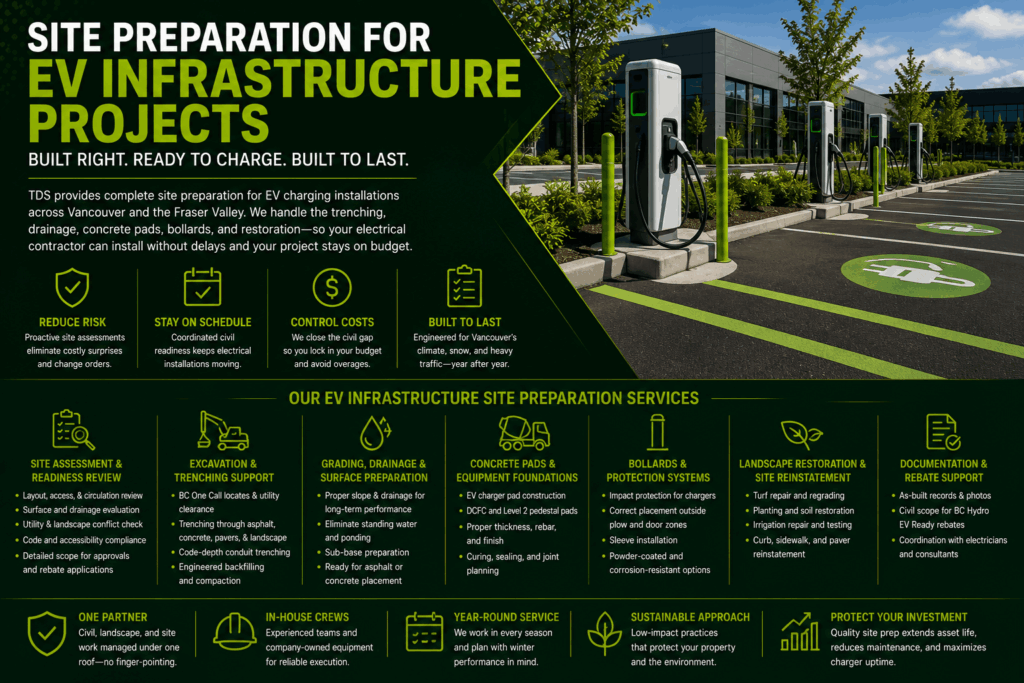
TDS eliminates this friction by providing comprehensive EV infrastructure site preparation Vancouver and across the Fraser Valley. The electrical install is the electrician’s job. The trench, the pad, the bollards, the drainage, the snow plow survival, and the landscape that has to look right when the project closes are ours. On most commercial EV projects, the gap between what the electrician scopes and what the property actually needs is where the trouble starts. TDS closes the gap.
By taking accountability for the entire civil footprint, we ensure your site is perfectly sequenced for the electrical contractor and built to survive a decade of Lower Mainland weather.
[Request an EV infrastructure site assessment →]
Site Preparation for EV Charger Installations in Vancouver
EV charging projects fail more often on site preparation than on electrical work. The electrician treats site readiness as a prerequisite, expecting an open trench, a cured pad, and installed bollards upon arrival. The EV consultant focuses purely on equipment and electrical loads. The property manager is left stranded in the civil gap where unaddressed site issues manifest as costly structural defects six to twelve months after the electrician departs.
TDS eliminates this risk by ensuring your infrastructure survives a decade of Lower Mainland rain, salt, snowplows, and heavy traffic.
Core Civil Risks and Failure Modes
- Traffic Flow and Space Layout. Proposed charger locations frequently block accessible stalls, fire lanes, or essential turning radiuses. A generic satellite quote misses these constraints while our initial site walk catches them.
- Surface Integrity. Heavily patched asphalt cannot support new pad loads and hairline concrete cracks will telegraph through new pours. We identify what must be excavated and rebuilt before any equipment is anchored.
- Grading and Drainage. Poorly leveled pads leave expensive charging units sitting in standing water by November. Managing the drainage and surface preparation for EV charging stations up front prevents having to demolish and repour pads post-installation.
- Subsurface Trenching. Conduits rarely run in a straight line. Unmapped utilities, irrigation lines, and tree protection zones alter routes. Identifying these during the initial walk eliminates sudden mid-dig change orders.
- Structural Pads and Bollards. Level 2 pedestals and heavy DC fast chargers require distinct, load-calibrated concrete pad specifications. Furthermore, bollards must be strategically placed outside winter plow paths and designated snow storage zones to prevent seasonal impact damage.
- Reinstatement Scope. Trenching through green space leaves an eyesore without dedicated landscaping restoration after EV infrastructure installation. We budget for irrigation reconnection, turf repair, and curb cut restoration from day one.
- BC Hydro Rebate Alignment. Missing or incomplete civil documentation is a primary reason CleanBC and BC Hydro EV Ready rebates are delayed or denied. Our precise site reporting feeds your application directly to secure funding.
- Trade Sequencing. We coordinate the civil-to-electrical handoff seamlessly. The trench is opened precisely when the electrician arrives and closed immediately after, minimizing tenant complaints and preventing costly project drift.
Our EV Infrastructure Site Preparation Services
- Site Assessment and Exterior Readiness Review
The initial site walk is the most critical phase of an EV project. This is where hidden costs are identified and eliminated. TDS conducts this evaluation alongside your electrical contractor or EV consultant to coordinate the civil and electrical frameworks from day one.
- Diagnostic Scope: We evaluate the existing parking layout, vehicle turning radiuses, drainage patterns, and surface conditions. We also assess potential landscape conflicts along the conduit route, equipment access limitations, tree protection zones, and BC Building Code accessibility compliance.
- Operational Planning: Our review accounts for real-world site usage, including winter snow storage zones, delivery paths, and pedestrian traffic flow.
- Deliverable: You receive a comprehensive written scope of work ready to hand directly to BC Hydro for EV Ready rebate applications, to your electrician for field coordination, and to your strata council or building owner for immediate approval.
- Excavation and Subsurface Trenching Support
Commercial EV trenching requires navigating complex underground networks. Our team manages the entire excavation footprint through landscape, asphalt, concrete, and pavers. We secure and track BC One Call utility locates across multi-day projects, ensuring all clearances remain valid before any digging begins.
- Code and Utility Compliance: We clear buried gas, water, telecom, drainage, and irrigation lines while avoiding protected tree root zones. Trenches maintain strict code depths, sitting 24 inches below finished grade and extending deeper through driveways and fire access routes. Within one metre of any marked utility, we deploy precise hand-digging or hydrovac excavation.
- Structural Backfilling: Once the licensed electrical contractor secures the conduit, we compact the backfill to strict engineering specifications rather than simply dumping the earth back into place. Proper compaction prevents the trench from settling, which otherwise creates severe pavement dips within a year and tripping hazards within two.
- Grading, Drainage, and Surface Preparation
Most Lower Mainland parking lots were not graded with EV infrastructure in mind, meaning optimal charger locations often sit in areas where water has pooled for years. TDS corrects these grade defects to ensure water drains completely away from your electronic equipment.
- Pad Engineering and Curing: We manage the drainage and surface restoration for EV charging tailored to the exact specifications of Level 2 pedestals or heavy DC fast chargers. This includes precise placement of embedded conduit penetrations. Our project schedules strictly account for seasonal concrete curing windows so structural integrity is never compromised for a rushed commissioning date.
- Water Mitigation: We eliminate winter surface ice, equipment base corrosion, and surrounding pavement erosion. Our teams handle slope corrections, install area drains or scuppers, handle storm tie-ins, and configure planter drainage to stop subsurface water from migrating toward the charging pads. We also eliminate uneven approaches to keep your new stalls fully compliant with accessibility standards.
- Landscape Restoration and Perimeter Design Upgrades
Trenching leaves a significant structural and visual scar across a property unless the reinstatement is planned from the start. TDS handles the delicate process of removing, preserving, and restoring your exterior assets so the finished frontage shows no signs of the recent excavation.
- Systematic Reinstatement: We carefully remove turf, plantings, and mulch ahead of the dig to maximize reinstallation. Any disturbed irrigation lines are re-routed and reconnected, and mature plants that cannot be saved are replaced with appropriately matched species.
- Defensive Landscape Design: Our approach to civil landscaping considerations for EV infrastructure upgrades addresses unique modern property risks. We select low-maintenance, salt-tolerant plantings and design hard edges to prevent mulch from migrating into the charger bases. Furthermore, we reconfigure irrigation spray patterns away from the electronics to protect manufacturer warranties, prune nearby trees to prevent debris from fouling charging cords, and maintain low sightlines to maximize user safety after dark.
- Civil Support for EV-Ready Retrofits
Executing a complete EV Ready retrofit places much of the practical site coordination into the civil scope. TDS helps prepare the exterior work, documentation, and construction sequence needed to support the rebate process without slowing down the electrical contractor. TDS specializes in managing these large-scale property conversions, which frequently qualify for BC Hydro EV Ready rebates.
- Future-Proof Infrastructure: We trench full conduit runs across multiple future stalls, install and safely cap concrete pads pending future hardware additions, and execute the complex vault excavations or transformer pad modifications required for service capacity upgrades.
- Regulatory Compliance: For multi-unit residential environments, our documentation is structured to support strata councils navigating the current majority-vote approval thresholds for EV infrastructure upgrades under the BC Strata Property Act, ensuring your civil investment aligns with both current engineering standards and future logistical demands.
Where EV Infrastructure Affects Commercial Landscaping and Civil Work
When an EV project goes over budget, it’s rarely because of the electrical components. The financial surprises almost always hide in the ground. Understanding these friction points before the equipment arrives is the single best way to protect your capital budget.
The Top 3 High-Risk Cost Drivers
- Drainage Paths and Slope: The most expensive surprise on Lower Mainland EV projects is discovering that a chosen location cannot drain without extensive regrading. If a contractor quotes your project using satellite data without checking the physical slope, this is where massive change orders surface.
- Utility Corridors and Existing Services: Trenching routes are strictly constrained by buried gas, water, telecom, drainage, and irrigation lines. On pre-1990 Lower Mainland commercial properties, as-built drawings are notoriously unreliable. The trench will often discover undocumented, active, or abandoned services.
- BC Building Code Accessibility Compliance: Curb cuts, ramp slopes, stall grades, signage placement, and approach widths around accessible EV stalls carry strict legal requirements. Remediation can range from a minor fix to the largest line item on your project, depending on your current layout.
Standard Scope Items to Anticipate
A successful installation requires looking at how your parking lot actually functions day-to-day. We actively plan for the mid-tier logistical items that keep a property running smoothly:
- Stall Layout and Restriping: Reconfiguring stall dimensions to accommodate charging cord reach, equipment clearances, and potential modifications to nearby landscape planters.
- Pad and Equipment Zoning: Forming load-calibrated concrete pads engineered not just for your current Level 2 or DC fast chargers, but sized to support future hardware expansions.
- Bollards and Wheel Stops: Installing heavy-duty protective bollards with deep concrete footings, positioned carefully to clear winter snowplow routes and emergency vehicles.
- Landscape and Subsurface Reinstatement: Systematically removing and replacing turf, beds, and mature plantings while repairing any irrigation lines broken along the trench path.
- Parkade Modifications: Managing the unique structural calculations, ventilation, drainage, and structural waterproofing membrane protections required for suspended slab parkade installations.
EV Infrastructure Site Preparation for Strata and Multi-Unit Buildings
Strata EV projects fail more often on governance than on construction. The engineering is straightforward, but navigating the compliance pathway is not. The 2023 amendments to the BC Strata Property Act lowered the approval threshold for certain EV-related decisions from a three-quarter to a majority vote, but councils still must manage complex administrative hurdles.
Between drafting council resolutions, timing Special General Meetings (SGMs), consulting depreciation reports, and securing BC Hydro EV Ready pre-approvals, the paperwork can stall a project for months. Partnering with a team that has executed this exact process across Metro Vancouver saves weeks of administrative friction.
Managing the Strata Footprint
On a strata property, the civil installation directly impacts common assets and resident day-to-day life. A successful project requires a contractor who takes accountability for the community, not just the concrete.
- Common Property Integrity: Trenching often cuts through shared gardens, walkways, courtyards, and access roads. We ensure our excavation and landscape restoration meet the council’s exact aesthetic standards so the property looks untouched when we leave.
- Proactive Resident Communication: We take the burden of occupant management off the property manager. TDS provides pre-written weekly progress notices and coordinates visitor and resident stall closures around the building’s actual occupancy patterns to minimize daily friction.
- Protecting Occupied Spaces: For parkades and podium decks, EV installations often intersect with existing waterproofing membranes. We ensure that anchoring charging equipment or running conduit does not compromise the envelope protecting the occupied spaces or vehicles below.
- Audit-Ready Documentation: We supply all civil, structural, and restoration data in the exact formats required for BC Hydro EV Ready rebate compliance and future BC Section 94 depreciation report updates.
The Value of Multi-Phase Continuity
Most strata corporations cannot afford to electrify every stall at once. They opt for multi-phase EV Ready projects, installing the core trenching, conduit runs, and panel capacity now, then adding chargers across multiple budget years.
This is where contractor continuity becomes your biggest financial asset. The specific conduit pathways, panel reserves, drainage adjustments, and soil conditions discovered during the initial dig form a critical site blueprint. If you re-bid every phase to a new contractor, that institutional knowledge disappears. TDS maintains your project history across every phase, protecting your long-term capital budget over a five-year expansion plan.
EV Infrastructure Site Preparation for Commercial and Municipal Properties
Commercial and municipal EV projects vary widely in scale, but they all share the exact same financial friction point: electrical service capacity. While adding two Level 2 stations at a retail plaza might slip under your current power threshold, electrifying a commercial fleet or installing public DC fast chargers completely changes the equation.
A single DC fast charging stall draws between 50 and 350 kilowatts. On many Lower Mainland properties, adding a cluster of these units requires more power than the entire existing building consumes. This massive power draw triggers extensive, multi-month negotiations with BC Hydro, shifting your project from a basic equipment installation into a major civil engineering undertaking.
The Civil Realities of a Service Upgrade
When BC Hydro confirms your property needs more power, the civil work required to bring that electricity to your site is extensive. This is where uncoordinated projects suffer severe budget and schedule creep.
- The Financial Footprint: A standard commercial-scale service upgrade generally run between $30,000 and $150,000, and they can easily scale into seven figures for large-scale fleet electrification.
- The Timeline Trap: BC Hydro service upgrade requests routinely take six to twelve months from initial engineering to final energization. These applications must be approved before your civil construction can even be scheduled. TDS ensures this paperwork is initiated on day one.
Civil Scope Demands by Property Type
Different properties face distinct operational challenges when integrating EV infrastructure. We tailor our civil and structural approach to fit your specific asset class:
- Retail Plazas and Shopping Centres
- Office Buildings and Business Parks
- Municipal Facilities and Institutional Sites
- Fleet and Transit Yards
- 24/7 Public Charging Hubs
Why Choose TDS for EV Infrastructure Site Preparation in Vancouver
EV infrastructure requires two distinct skill sets. The electrical hookup requires a licensed electrician. The physical site footprint requires a commercial civil contractor. Most quotes on the market come from electricians trying to manage heavy excavation, or civil crews guessing at EV-specific requirements.
TDS specializes strictly in the civil footprint. We partner directly with your electrical contractor to ensure the physical site stands up to a decade of Lower Mainland weather, heavy traffic, and winter maintenance.
- Locally owned and operating since 2010 across Metro Vancouver and the Fraser Valley.
- 100% in-house civil crews spanning excavation through final landscape reinstatement.
- Full fleet of company-owned heavy equipment.
- Active WorkSafeBC compliance with comprehensive, project-specific safety planning.
- Certified carbon-neutral operations with verified offsets.
TDS does not install chargers. We make sure the site works long after they are installed.
Our Process for EV Charger Site Preparation Projects
Site Review and Project Coordination
Every project begins with a structured site walk alongside your electrical contractor and EV consultant, aligning directly with your pre-construction trade meetings. Within three to seven business days, we deliver an itemized scope of work and a trade-sequenced schedule. This document explicitly defines task ownership, eliminating the overlapping gaps where costly multi-trade project delays typically occur.
Coordination with EV and Electrical Contractors
TDS executes the civil infrastructure while actively supporting your licensed electrical installer, formalizing all trade interfaces in writing before mobilization. We lock in mobilization timelines, strict conduit penetration tolerances, and concrete pad curing dates relative to the electrical hookup schedule.
Furthermore, we deliver all civil engineering documentation in the precise formats required for BC Hydro EV retrofit requirements for commercial developments to facilitate seamless pre-approvals and final rebate distributions. On properties requiring utility power upgrades, all BC Hydro on-site inspections and attendance metrics are integrated directly into our master construction timeline.
Excavation, Grading, Drainage, and Surface Preparation
Physical site work deploys strictly on your contracted schedule. We initiate and track BC One Call utility locates across multi-week projects, executing mandatory locate refreshes before any subterranean clearances expire mid-trench. Daily site logs, soil compaction test results, and locate validation histories are tracked digitally to feed into your permanent building record.
If unforeseen subsurface conditions arise, change orders are documented immediately with scope, cost, and schedule impacts. Minor adjustments below your pre-agreed financial threshold are resolved on-site by our coordinator to keep the trench moving, while major variances route instantly to your property manager for written sign-off.
Backfill, Cleanup, and Landscape Restoration
We treat surface reinstatement as a primary engineering phase rather than an afterthought. Subsurface backfill is machine-compacted to engineering density metrics to prevent asphalt settling, and disturbed landscapes undergo seamless restoration after EV infrastructure installation.
We carefully preserve and reuse original bed soils, mulch, and healthy root systems, supplying exact-match botanical replacements only where required. Hard surfaces are saw-cut, sealed, and patched to mirror the existing grade and finish, and the scope finishes with a formal walkthrough, deficiency review, and a complete closeout package containing as-built conduit paths and validated rebate submittals.
Ongoing Exterior Maintenance Support
Long-term infrastructure survivability requires active, seasonal site management, and your original TDS project lead remains your point of contact across your entire warranty term. For properties utilizing our recurring grounds maintenance contracts, your EV stations are integrated directly into your seasonal operations plan.
We ensure chargers remain highly visible to winter maintenance crews to prevent plow impacts, clear surrounding overgrowth to preserve security sightlines, and monitor localized grade changes so your drainage and surface preparation for EV charging stations continues to divert runoff properly as your parking lot asphalt ages.
Areas We Serve
TDS provides EV infrastructure site preparation across Metro Vancouver, the Lower Mainland, and the Fraser Valley, including:
- Vancouver (including Yaletown, Coal Harbour, the Cambie corridor, Mount Pleasant, and Downtown)
- Burnaby (including Brentwood, Metrotown, and Lougheed)
- Richmond
- Surrey (including Guildford, Newton, Whalley, Fleetwood, and Cloverdale)
- North Vancouver (including Lonsdale and the waterfront)
- West Vancouver (including the British Properties)
- New Westminster
- Coquitlam and the Tri-Cities
- Delta (including Tilbury and Annacis Island industrial areas)
- Langley (including Willoughby and Walnut Grove)
- Port Kells and Fraser corridor industrial areas
- Metro Vancouver
- Lower Mainland
- Fraser Valley
Request an EV Infrastructure Site Preparation Quote in Vancouver
An EV charging project is only as reliable as the civil work beneath it. Whether you are planning a two-stall retail upgrade or a multi-phase, parkade-wide rollout under the BC Hydro EV retrofit requirements for commercial developments program, the physical installation determines your long-term success. Do not leave your capital budget vulnerable to uncoordinated civil trades, sinking trenches, or winter drainage failures.
Partner with the Lower Mainland’s trusted commercial site specialists to secure a predictable budget, seamless trade sequencing, and infrastructure built to survive the elements.
FAQs About EV Infrastructure Site Preparation in Vancouver
What is EV infrastructure site preparation?
EV infrastructure site preparation is the civil, structural, and landscape work required around an EV installation. While a licensed electrician handles the internal wiring and equipment hookups, TDS manages the physical exterior footprint, which includes utility trenching, grade correction, pouring concrete pads, installing protective bollards, and restoring the surrounding surface.
Does TDS install EV chargers?
No, TDS does not install EV chargers. Charger mounting and electrical activation require a licensed electrician or certified equipment installer. TDS focuses entirely on the heavy civil excavation, structural concrete, drainage management, and property restoration work, coordinating directly with your electrical trade to ensure a seamless handoff.
Why is drainage and surface preparation for EV charging stations so critical?
Drainage and surface preparation for EV charging stations is critical because Lower Mainland rainwater naturally pools around poorly graded equipment bases. This creates severe winter slip-and-fall ice liabilities, accelerates structural corrosion on expensive electronics, and destroys the surrounding asphalt, making upfront slope correction essential to avoid costly structural remediation.
Can TDS handle landscaping restoration after EV infrastructure installation?
Yes, TDS handles complete landscaping restoration after EV infrastructure installation. Our in-house teams machine-compact subsurface backfill to eliminate pavement settling, saw-cut and patch concrete or asphalt to match the existing finish, and fully reinstate all disturbed turf, planting beds, and irrigation systems so the excavation route is virtually invisible.
Do strata buildings in BC require special approvals before starting an EV project?
Yes, strata buildings in BC require formal council approval and a majority vote before starting an EV project on common property. While recent BC Strata Property Act amendments lowered the voting threshold from a three-quarter to a simple majority, councils must still formally align resolutions and secure BC Hydro EV Ready pre-approval before buying equipment to guarantee rebate compliance.
What specific commercial properties require dedicated civil site preparation?
The specific commercial properties that require dedicated civil site preparation include retail plazas, commercial office parks, multi-family strata complexes, municipal facilities, and industrial fleet yards. The physical scope scales by asset, ranging from simple perimeter trenching for retail stalls to heavy-duty pavement design, transformer vault excavations, and strict BC Hydro EV retrofit requirements for commercial developments alignment for high-output fleet electrification.