
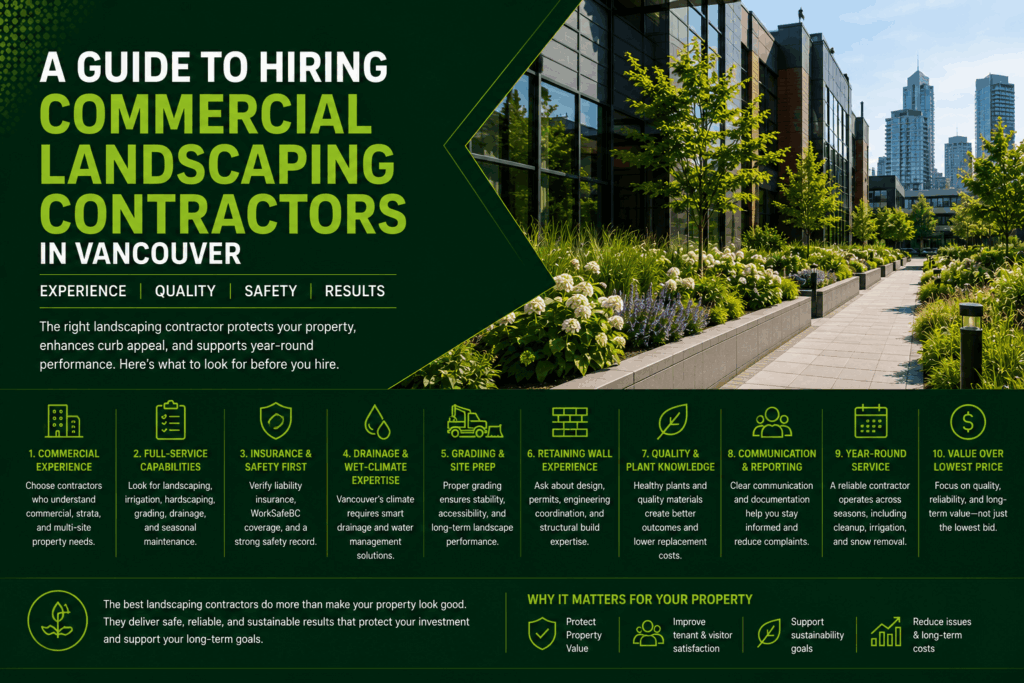
Not every landscaping contractor is set up for commercial, strata, municipal, or complex site work. Vancouver’s wet climate, drainage demands, sloped terrain, retaining wall requirements, and year-round maintenance cycles all put pressure on properties that a general gardener or one-trade specialist simply is not equipped to manage.
If you are hiring a landscaping contractor for a commercial property, strata complex, business park, retail plaza, or institutional site, the vetting process needs to go well beyond price and availability. You need to know whether the contractor can handle grading, drainage, irrigation, hardscaping, retaining walls, safety documentation, and winter maintenance, and whether they have the crews and equipment to deliver consistently across seasons.
Need a commercial landscaping contractor in Metro Vancouver? Talk to TDS.
What Does a Landscaping Contractor Do?
A landscaping contractor plans, builds, improves, or maintains exterior spaces. For commercial and strata properties, the scope can include lawn care and grounds maintenance, planting and pruning, irrigation system support, hardscaping, retaining walls, grading and drainage, site preparation, vegetation management, snow and ice management, and long-term maintenance contracts.
The distinction that matters for commercial property decision-makers is the gap between a landscaping contractor who handles small garden beds and one who can coordinate multi-building grounds work, manage access around tenants and the public, and maintain documentation that property managers actually need. A contractor focused on small private gardens may do excellent work on a single backyard, but struggle with the scheduling, safety, coordination, and reporting demands that come with a commercial or strata site.
When to Hire a Commercial Landscaping Contractor in Vancouver
The right time to bring in a commercial landscaping contractor depends on what the property needs and how much coordination is involved. Common triggers include recurring landscape maintenance for a commercial or strata site, drainage or pooling issues that affect access and safety, slope stabilization or retaining wall work, grading before landscape improvements or hardscape installation, vegetation cutback on industrial or institutional properties, irrigation system support or seasonal planting, and the need to consolidate landscaping and winter maintenance under one vendor.
If the property involves tenants, residents, public traffic, or active operations, the contractor needs to understand scheduling, safety, site documentation, and communication at a level that goes beyond basic lawn care. A strata property with 200 units and shared common areas requires a fundamentally different management approach than a single standalone home, and the landscaping contractor needs to be prepared for that complexity.
10 Things to Look For Before Hiring Landscaping Contractors in Vancouver
Choosing the right landscaping contractor for a commercial property means evaluating capability, accountability, and fit across several dimensions. The following factors matter most for properties where safety, access, tenant experience, and long-term maintenance quality are on the line.
1. Commercial and Strata Property Experience
Commercial and strata projects involve access logistics, resident and tenant considerations, public safety, scheduling constraints, site documentation, and ongoing communication with property managers or strata councils. Contractors who primarily serve homeowners may not be prepared for the coordination these sites demand.
Look for proven experience across property types such as strata complexes, retail plazas, office parks, hotels, industrial sites, business campuses, and municipal or institutional properties. Ask for references from properties similar to yours, because experience on a small backyard renovation does not translate to managing a multi-building commercial grounds contract.
2. Proper Insurance, WorkSafeBC Coverage, and Safety Practices
Ask for proof of liability insurance and WorkSafeBC coverage before signing anything. On active commercial sites, especially those involving slopes, retaining walls, excavation, parking lots, or pedestrian areas, safety documentation and crew training are not optional.
A qualified contractor should be able to show site-specific safety planning, equipment operation protocols, and training records without hesitation. If a contractor is evasive about insurance or safety documentation, that alone is reason enough to move on, because the liability exposure on a commercial property is far higher than on a small private job.
3. Experience With Vancouver Drainage and Wet-Climate Site Conditions
Vancouver’s heavy rainfall, saturated soils, poor runoff patterns, and freeze-thaw cycles create real problems on commercial properties. A landscaping contractor working in this market needs to understand drainage around hardscape and planting areas, retaining wall drainage, grading corrections, standing water, and long-term water management.
Poor drainage affects foundation performance, surface longevity, planting survival, pedestrian safety, and parking lot conditions, and those problems compound over time if they are not addressed early. If the contractor cannot speak to how they handle wet-climate conditions on commercial sites, that is worth noting before you go further.
4. Grading and Site Preparation Capability
Grading affects drainage, accessibility, landscape performance, hardscape stability, and safety. For commercial properties, this can include slope correction, subgrade preparation, surface levelling, parking-area or walkway preparation, lawn establishment, water-flow management, and preparation for retaining walls, pavers, or planting areas.
Not every landscaping contractor has the equipment or experience for grading work, and poorly executed grading creates drainage problems that are expensive to fix after the fact. Confirm grading capability early if the property requires it, especially for projects that involve sloped terrain, new hardscape installations, or areas with standing water.
5. Retaining Wall and Slope Experience
Retaining walls are one of the more technically demanding elements in commercial landscaping. Depending on height, load, slope, location, and municipality, a retaining wall may require engineering, drainage design, permits, and careful site assessment. This is especially relevant for commercial and strata properties where walls support parking areas, walkways, or structures, or where the wall is taller than a few feet and carries significant earth pressure.
Ask how the contractor evaluates wall requirements, whether they coordinate with engineers when needed, and how they handle drainage behind the wall. Vague answers here are a red flag, because a retaining wall that fails or was built without required engineering review creates both safety and compliance problems.
6. Hardscaping and Landscape Construction Skill
Hardscaping on commercial sites can include pavers, walkways, patios or plazas, retaining walls, steps, curbs, planters, and drainage integration around hardscape surfaces. The quality of the base preparation, drainage planning, and material selection determines whether the work holds up under heavy foot traffic, vehicle loads, and Vancouver’s wet winters.
Ask for project examples and check whether the contractor handles both the hardscape installation and the drainage beneath it. Hardscape that shifts, settles, or pools water within a few seasons usually points back to inadequate base preparation or missing drainage, both of which should have been addressed during construction.
7. Irrigation and Planting Knowledge
For properties with turf, planting beds, or seasonal displays, irrigation management is part of the maintenance equation. Ask whether the contractor handles irrigation monitoring, seasonal adjustments, leak identification, water-conscious planting, native or climate-appropriate species selection, and long-term plant health planning.
A contractor who installs planting without thinking about irrigation and water management is setting the property up for replacement costs down the road. Vancouver’s dry summers and Metro Vancouver watering restrictions make irrigation efficiency a practical necessity, not just an environmental preference.
8. In-House Crews and Equipment Capacity
Larger commercial sites need reliable equipment, dispatch capacity, experienced crews, and project coordination. Contractors who rely heavily on subcontractors can struggle with consistency, communication, and accountability on complex properties. Ask whether the crews are in-house, whether the equipment is company-owned, and whether there is direct supervision on site.
For commercial property managers, the cheapest contractor can quickly become the most expensive one if they cannot scale, communicate, complete work safely, or maintain consistent crew assignments on the property.
9. Year-Round Maintenance and Snow and Ice Support
A landscaping contractor that also handles winter maintenance can reduce vendor coordination and ensure continuity across seasons. This is especially valuable for commercial, strata, and mixed-use properties that need spring cleanup, summer grounds maintenance, fall leaf removal, winter preparation, snow and ice management, de-icing, and storm debris response without switching contractors partway through the year.
When separate vendors handle summer and winter, the transition between seasons often creates gaps in coverage, and issues identified during fall preparation may not get communicated to the winter crew.
10. Clear Contracts, Communication, and Reporting
A strong contract should clearly define scope of work, service frequency, included and excluded services, seasonal tasks, change-order process, site contact, reporting or visit notes, emergency response expectations, pricing structure, and renewal terms. If any of these are missing or vague before the contract is signed, they will be a problem after.
Property managers who have been through a contract dispute with a landscaping contractor will tell you that the scope of work clause and the exclusions list are the two most important things in the agreement.
Questions to Ask Landscaping Contractors Before Hiring
Before signing a contract, the following questions can help property managers evaluate fit and reduce the risk of scope confusion or service gaps down the line.
| Question | Why It Matters |
| Have you worked on commercial or strata properties like ours? | Confirms relevant site experience |
| Are you insured and covered by WorkSafeBC? | Helps reduce risk on active properties |
| Do you use in-house crews or subcontractors? | Clarifies accountability and consistency |
| Can you handle grading, drainage, hardscaping, or retaining walls? | Shows whether they manage complex exterior work |
| Do retaining walls or slope work require engineering or permits? | Prevents compliance and safety issues |
| Do you provide irrigation support? | Protects plant health and water efficiency |
| Do you offer snow and ice management? | Supports year-round property operations |
| How do you document completed work? | Helps property managers track service quality |
| What is included in the contract? | Reduces scope confusion |
| How do you handle urgent repairs or site issues? | Clarifies responsiveness |
If the answers to these questions are detailed and specific, that is a good sign. If they are vague or evasive, keep looking.
Landscaping Contractors for Commercial and Strata Properties
Commercial and strata sites need contractors who can manage shared common areas, tenant and resident expectations, safety around active buildings, maintenance schedules, vendor communication, snow and ice planning, drainage and access issues, larger equipment and crew needs, and long-term contracts. The contractor needs to understand that work on these properties happens around people, vehicles, schedules, and sometimes competing priorities from strata councils or property management teams. The scheduling alone is more complex than basic garden maintenance, because crews need to work around business hours, resident routines, deliveries, and public access requirements.
TDS is built for commercial, municipal, institutional, and strata properties that need more than basic landscape maintenance. Its landscape, grounds, and vegetation services connect landscaping with vegetation management, snow and ice management, site repairs and waterproofing, civil excavation, and environmental services.
Landscaping Contractors for Retaining Walls, Grading, and Drainage
Retaining walls, grading, and drainage form a connected system on sloped or water-affected commercial properties. A retaining wall without proper drainage behind it will fail. Grading that does not direct water away from buildings, walkways, and parking areas creates pooling, erosion, and long-term surface damage. For commercial and strata sites in Vancouver, these three elements often need to be planned together rather than treated as separate line items from separate contractors.
When soil on a sloped commercial property is saturated after heavy rain, the pressure behind a retaining wall increases significantly. If the drainage system behind that wall was not designed to handle that load, the wall moves, cracks, or eventually fails. The same principle applies to grading around hardscapes, planting beds, and parking surfaces. Water that is not directed away from the property causes damage that accumulates over seasons.
For structural retaining walls, slopes, or drainage changes near buildings or property lines, ask whether engineering, permits, or municipal review may be required. The answer will vary by municipality and project conditions, but a qualified contractor should know enough to flag when those steps are necessary.
Landscaping Contractors for Hardscaping and Irrigation
Hardscaping and irrigation are two of the most common project categories in the Vancouver commercial landscaping market. Pavers, walkways, planters, curbs, retaining structures, and drainage under hardscapes all affect how a commercial property functions and ages. Irrigation system planning, planting zone design, seasonal watering needs, and commercial-site durability determine whether the landscape investment holds up or turns into a recurring repair budget.
When evaluating a contractor for hardscaping or irrigation work, ask about both the installation approach and the long-term maintenance plan. A paver walkway that is installed without proper drainage will shift and pool water within a few seasons, and an irrigation system that is not monitored and adjusted seasonally will waste water and fail to protect the planting it was designed to support.
Red Flags When Hiring Landscaping Contractors in Vancouver
Some warning signs are easy to spot if you know what to look for. Be cautious of a contractor who displays any of these warning signs:
- Missing credentials: They cannot provide proof of insurance or WorkSafeBC coverage, or they quote pricing that seems too good to be true.
- Poor documentation: They offer no written scope of work, have no clear change-order process, or communicate poorly before the contract is signed.
- Lack of experience: They have no commercial or strata references, and they lack a safety plan for active commercial properties.
- Engineering gaps: They give vague answers about drainage, or they quote retaining walls without mentioning required drainage and engineering.
- Incomplete planning: They do not offer winter or seasonal maintenance planning for the property.
If more than one or two of these apply, the risk of problems during the contract increases significantly. Poor communication before the contract is signed almost always gets worse after.
Why Choose TDS as Your Commercial Landscaping Contractor?
TDS focuses on commercial, municipal, institutional, and strata properties that need coordinated, year-round exterior property support. The company operates with 100% in-house crews, company-owned equipment, and direct field supervision across Metro Vancouver and the Fraser Valley.
Services span landscape and grounds maintenance, snow and ice management, site repairs and waterproofing, civil excavation, and sensitive habitat and environmental services, which means property managers can consolidate multiple exterior needs under one accountable contractor instead of juggling separate vendors for every season and service type.
TDS has operated locally since 2010, with safety planning and WorkSafeBC alignment built into its operations. For properties where documentation, crew accountability, equipment readiness, and long-term consistency matter, TDS is a strong fit worth evaluating.
You can review completed projects or learn more about TDS’s approach before reaching out.
When TDS May Not Be the Right Fit
TDS is best suited to commercial, strata, municipal, institutional, and larger property sites where safety, access, drainage, maintenance scope, and long-term service quality are the priority. Small backyard projects, one-off garden design, DIY planting advice, or tiny cosmetic projects without a commercial or strata scope are generally outside TDS’s core focus.
Request a Commercial Landscaping Contractor Quote in Vancouver
If your property needs a landscaping contractor with commercial maintenance discipline, grading and drainage capability, winter support, and the operational depth to handle complex exterior work, contact TDS Vancouver to discuss your site, scope, safety requirements, and maintenance needs.
FAQs About Choosing Landscaping Contractors in Vancouver
How Do I Choose a Trustworthy Landscaping Contractor in Vancouver?
Look for commercial or strata experience, proof of insurance and WorkSafeBC coverage, clear contracts, safety practices, in-house crews, strong communication, and experience with Vancouver-specific issues such as drainage, grading, retaining walls, and seasonal maintenance. A contractor who can answer detailed questions about these areas with specific examples is generally more reliable than one who speaks in generalities.
Do Landscaping Contractors in Vancouver Need to Be Licensed?
Licensing and permit requirements depend on the type of work. Basic maintenance may not require the same approvals as retaining walls, drainage changes, excavation, or work near regulated trees or public property. For structural, slope, drainage, or municipal work, ask the contractor what permits, engineering, or approvals may be needed for the specific project and location.
Which Landscaping Contractors in Vancouver Handle Commercial Sites?
Commercial sites are best served by contractors with experience working around tenants, residents, customers, parking areas, access routes, safety requirements, and recurring maintenance schedules. TDS focuses on commercial, municipal, institutional, and strata properties across Metro Vancouver and the Fraser Valley, with services that extend beyond landscaping into snow and ice management, site repairs, and civil work.
What Should I Ask Landscaping Contractors Before Hiring?
Ask about similar projects, insurance, WorkSafeBC coverage, in-house crews, equipment, grading and drainage experience, retaining wall knowledge, irrigation support, snow and ice services, reporting, contract scope, and how changes or urgent issues are handled. The depth and specificity of the answers will tell you more than the answers themselves.
Can Landscaping Contractors Handle Retaining Walls and Grading?
Some landscaping contractors handle retaining walls, grading, and slope work, but complex projects may require engineering, permits, drainage planning, or civil support. Always ask how the contractor evaluates wall height, slope, surcharge loads, drainage requirements, and municipal regulations before assuming the work can proceed without additional professional input.
Do Commercial Landscaping Contractors Provide Year-Round Maintenance?
Many commercial landscaping contractors provide year-round maintenance that can include lawn care, pruning, planting, seasonal cleanup, irrigation support, storm cleanup, and snow and ice management. Confirm exactly what is included in the contract, because “year-round” can mean very different things depending on the contractor and the scope they are quoting.