
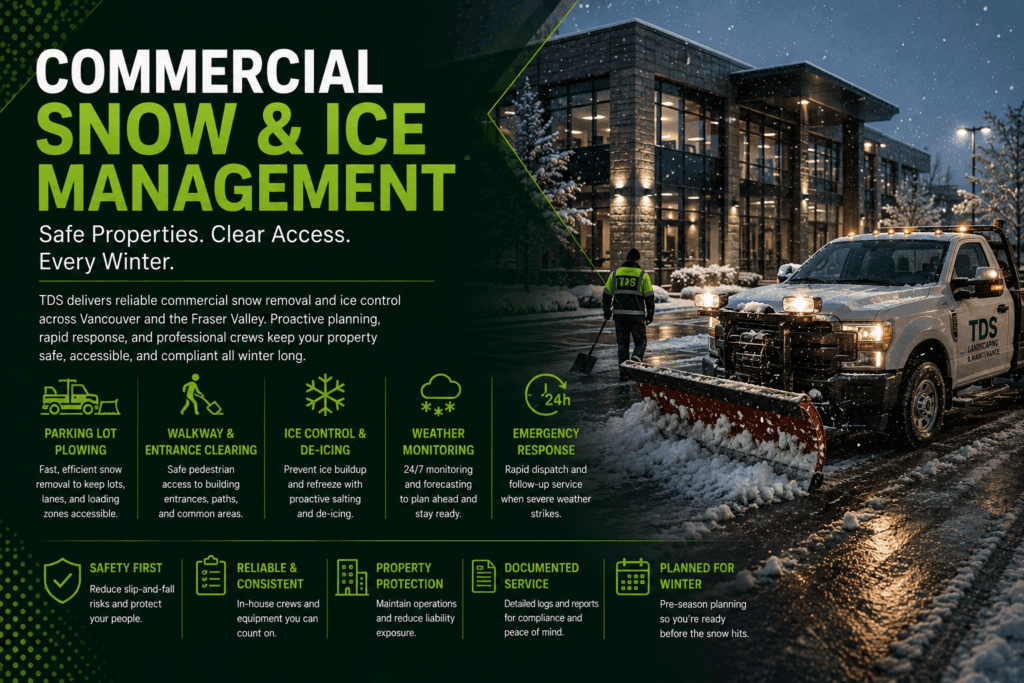
TDS provides commercial snow removal and ice management for commercial, strata, municipal, institutional, and mixed-use properties across Vancouver, Metro Vancouver, and the Fraser Valley. Our services include parking lot plowing, walkway clearing, de-icing, ice control, winter monitoring, and emergency snow response, delivered by in-house crews with company-owned equipment. Snow and ice management is where TDS started in 2010, and it remains a core part of how we support commercial properties through every season.
Request a commercial snow removal quote.
Commercial Snow Removal Services for Vancouver Properties
Vancouver snow events may be less frequent than what other Canadian cities experience, but when snow or freezing rain arrives, commercial properties still need fast, organized service. The difference between a property that stays accessible and one that creates liability exposure, tenant complaints, and operational disruption often comes down to whether the snow contractor was ready before the weather hit, not how quickly they scrambled after it did.
Commercial snow removal in Vancouver is about keeping customer, tenant, resident, and employee access open, maintaining parking lot safety, clearing entrances and walkways, managing ramps and loading zones, controlling ice during freeze-thaw cycles, monitoring weather and planning dispatch, and reducing winter disruption for active properties. For strata complexes, retail plazas, business parks, office buildings, industrial sites, and institutional properties, the stakes are different from a residential driveway because more people are using the property, more vehicles are moving through it, and more documentation is expected when something goes wrong.
Our Commercial Snow and Ice Management Services
TDS delivers snow and ice management as a structured winter operations program, not a reactive phone call when the snow starts falling. Each service component is planned before winter arrives and executed according to site-specific priorities, trigger points, and communication protocols that are defined during pre-season planning.
Parking Lot Snow Removal and Plowing
We plow commercial parking lots, retail plazas, business parks, industrial yards, multi-unit residential parking areas, access lanes, and loading zones. Priority areas such as entrances, exits, high-traffic zones, and accessible routes are cleared first to restore site access as quickly as conditions allow. Snow stacking locations are identified during pre-season planning so that piles do not block stalls, drains, visibility, or emergency access.
Parking lot plowing requires more than a truck and a blade. The crew needs to know the site layout, where the priority zones are, where snow can be safely stacked without blocking drainage or sightlines, and how to manage the lot when it is partially full of vehicles. We plan all of this before winter, so the first snow event is not a discovery exercise. For larger commercial lots, the plowing sequence matters because clearing in the wrong order can trap vehicles, block loading zones, or push snow into areas that create secondary access problems.
Sidewalk, Walkway, and Entrance Clearing
Building entrances, pedestrian walkways, common paths, courtyards, access points, storefronts, and resident and visitor routes all need to be cleared and maintained during and after snow events. This is especially important for strata, retail, office, institutional, and mixed-use properties where foot traffic is constant and slip-and-fall risk carries real liability consequences. A clear parking lot does not help if the walkways between the lot and the building entrance are still covered in snow or ice.
For properties with heavy foot traffic, walkway clearing needs to happen early and be maintained throughout the event, not just addressed once after the snow stops. TDS coordinates walkway and entrance clearing as part of the overall site response, not as a separate task that gets handled after the parking lot is done. Accessible routes, ramps, and emergency exits receive priority attention because these areas have both safety and regulatory implications that cannot be deferred.
Ice Control and De-Icing Services
Snow removal alone does not solve the winter access problem. Ice forms during freeze-thaw cycles, after plowing when moisture refreezes, and as black ice on surfaces that appear clear. Our ice control services include salting and de-icing, ice prevention, refreeze management, and treatment of ramps, steps, walkways, and parking surfaces. We apply de-icing after plowing and continue monitoring after snowfall stops, because the most dangerous conditions often develop after the storm passes and temperatures fluctuate.
Vancouver’s coastal climate makes freeze-thaw cycles particularly unpredictable, which means a property that was plowed and salted in the morning can develop black ice by evening. Ongoing monitoring and follow-up treatment are what separate a professional de-icing program from a one-pass-and-done approach. We calibrate de-icer application to site conditions and surface types, because over-application wastes material and can damage surfaces, while under-application leaves dangerous conditions unaddressed.
Emergency Snow Response for Commercial Facilities
When active snow or ice events require rapid response, TDS provides weather-triggered dispatch, priority site access, support for high-traffic or essential facilities, communication with property managers, and follow-up service after conditions change. Our safety and operations model includes monitoring that supports timely dispatch for sites requiring rapid response, so that crews and equipment are mobilized based on weather conditions rather than waiting for a phone call.
For commercial properties with critical access requirements, such as medical facilities, retail operations, or distribution centres, the response plan is defined before winter and activated based on agreed trigger points. This keeps the process organized even during heavy snowfall when every property in the city is calling for service at the same time. The difference between a prepared contractor and a reactive one becomes most visible during the events that matter most.
Snow and Ice Management for Strata Properties
Condo and townhouse communities, shared entrances, visitor parking, resident walkways, ramps, garages, and common areas all require winter maintenance that is coordinated with property managers and strata councils. Strata properties face unique challenges because residents expect cleared access before their morning commute, visitors need safe parking and pathways, and councils need documentation showing that winter maintenance was performed consistently and on schedule.
Communication with strata managers is especially important during active weather events. TDS provides updates and service documentation so that property managers can respond to resident inquiries with accurate information about what has been done and what is planned next. For strata councils, this documentation also supports due diligence in case of a slip-and-fall incident or a resident complaint. The combination of consistent winter service and clear communication is what separates professional strata snow management from reactive, complaint-driven responses.
Winter Maintenance for Mixed-Use, Retail, and Industrial Properties
Retail plazas need customer access throughout business hours. Warehouses need loading zone and service area clearance for incoming and outgoing shipments. Business parks need multi-building coordination so that one building’s tenants are not cleared while another building’s are left waiting. Office complexes need entrance and walkway safety for employees and visitors. Mixed-use developments need residential and commercial access handled simultaneously without one side being prioritized over the other. Industrial yards need equipment access and safe operational zones.
Each property type has different priority areas, traffic patterns, and response expectations, and the winter maintenance plan should reflect those differences rather than applying a generic one-size approach.
Seasonal Snow Contracts and Winter Maintenance Planning
TDS builds winter maintenance plans before the season starts. Pre-season site assessment, service maps, priority zones, trigger points, de-icing plans, snow storage areas, communication protocols, and documentation expectations are all defined in advance so that when winter weather arrives, the response is organized and site-specific.
Seasonal contracts give property managers clear expectations around scope, response, and reporting, which is significantly better than scrambling to find a contractor after the first snowfall. Pre-season planning also allows the contractor to allocate equipment and crew resources to specific sites, which improves response time and reduces the chaos that comes with ad-hoc winter service requests. For property managers who have experienced the scramble of trying to secure a snow contractor during an active weather event, the value of a pre-season contract is immediately obvious.
What Commercial Properties Need Snow and Ice Management?
Any commercial property with pedestrian, vehicle, or operational traffic during winter months should have a snow and ice management plan in place. This includes retail plazas, office buildings, industrial facilities, warehouses, business parks, strata developments, mixed-use buildings, municipal properties, institutional properties, construction and development sites, commercial parking lots, and parkades, ramps, and access roads.
The common thread is that people use these properties in winter, and the property owner or manager has a responsibility to keep access safe and documented. In the case of strata properties, the obligation extends to residents, visitors, delivery personnel, and emergency vehicles. When it comes to retail properties, it extends to customers and employees. For industrial properties, it extends to workers, delivery drivers, and equipment operators.
The property type determines the priority areas and response expectations, but the need for a plan is universal across commercial sites in Metro Vancouver.
Why Ice Management Matters as Much as Snow Removal
Snow removal clears the obvious problem. Ice management handles the one that is harder to see and just as likely to cause an injury or a complaint. After a snow event, freeze-thaw cycles can create black ice on pedestrian routes, refrozen slush in parking lots, slick conditions on ramps and loading zones, and dangerous surfaces in areas that appeared clear hours earlier. A property that plows and walks away without de-icing is only half-managed.
Ice control requires follow-up monitoring, targeted de-icer application, and attention to conditions that change after the initial clearing. For property managers, documented ice management also provides a record of due diligence if an incident or complaint occurs. Slip-and-fall claims are one of the most common winter liability issues for commercial properties, and the ability to produce timestamped service records showing when de-icing was applied and where can make a significant difference in how those situations are resolved.
Professional winter maintenance means treating ice with the same seriousness as snow, not as an afterthought that only gets attention when someone calls to report a fall.
Commercial Snow Removal Contracts in Vancouver
A clear winter maintenance contract protects the property and sets expectations for both the contractor and the property manager. The following elements should be defined before winter arrives, not negotiated during the first snowstorm.
| Contract Consideration | Why It Matters |
| Priority zones | Ensures entrances, walkways, ramps, and access routes are cleared first |
| De-icing plan | Helps reduce black ice and refreeze risks |
| Site map | Gives crews clear instructions during active weather |
| Response triggers | Clarifies when service begins based on accumulation or conditions |
| Documentation | Supports property managers if incidents or complaints happen |
| Snow storage | Prevents piles from blocking stalls, drains, visibility, or access routes |
| Communication process | Defines how updates, site changes, and weather advisories are handled |
| Seasonal scope | Outlines what is covered from first snow to spring, including follow-up visits |
If these elements are defined and agreed upon before winter, the service runs smoother and the property manager has fewer gaps to worry about when conditions deteriorate. A winter maintenance contract is not a nice-to-have. For commercial properties, it is the operational plan that determines whether winter weather creates a crisis or a manageable routine.
Why Choose TDS for Commercial Snow Removal in Vancouver?
TDS started as a snow removal contractor in 2010 and has been managing winter operations for Metro Vancouver commercial properties since day one. That is not an add-on service or a side business. It is where the company began, and it remains central to how we operate. Every aspect of our winter operations, from crew training to equipment maintenance to dispatch protocols, reflects over a decade of experience managing snow and ice on commercial, strata, municipal, and institutional sites across the region.
Today, TDS serves commercial, municipal, institutional, and strata properties with 100% in-house crews, a fleet of over 50 company-owned pieces of equipment, WorkSafeBC-aligned safety planning, and monitoring that supports timely dispatch for sites that require rapid response. We are locally owned, and our management team makes operational decisions directly rather than routing them through a national call centre or franchise structure. When conditions change during an active weather event, our team adjusts in real time because the decision-makers are local and accessible.
For properties where winter access, documentation, crew accountability, and reliable response matter, TDS is built for that work. You can review completed projects and learn more about TDS’s safety and certifications to see how winter operations fit into our broader approach to property management.
Year-Round Property Maintenance Beyond Winter
Many TDS clients use our snow and ice management services in winter and our broader exterior property services throughout the rest of the year. Because TDS operates as a year-round property maintenance partner, winter and non-winter services are coordinated rather than siloed, which means fall preparation feeds into winter planning and spring recovery picks up where winter left off. The crew that managed winter operations already knows the site, the drainage issues, the access priorities, and the communication preferences, so the transition into spring maintenance happens without the ramp-up period that comes with bringing in a new contractor.
Beyond snow and ice, TDS provides landscape, grounds, and vegetation services, site repairs and waterproofing, civil excavation and earthworks, and sensitive habitat and environmental services. For property managers who want one accountable partner across all four seasons rather than a different contractor for every service, TDS’s model is built around exactly that idea: Four Seasons. One Standard. Consolidating exterior property services under one provider reduces coordination overhead, improves communication, and ensures that issues identified in one season are carried forward into the next.
Areas We Serve
TDS provides commercial snow removal and ice management across Vancouver, Burnaby, Richmond, Surrey, North Vancouver, West Vancouver, New Westminster, Coquitlam, Delta, Langley, and the broader Metro Vancouver and Fraser Valley regions. Our fleet and crew capacity allow us to serve multiple commercial sites across the region, and our local base means we are positioned to respond when conditions require it rather than dispatching from a distant location.
Request a Commercial Snow Removal Quote in Vancouver
If you need reliable snow removal, ice control, or winter maintenance for a commercial, strata, industrial, retail, or mixed-use property, contact TDS Vancouver to discuss your site, winter priorities, and service plan. Pre-season planning gives both sides the best start, so reaching out before winter arrives is always the right move.
FAQs About Commercial Snow Removal in Vancouver
What Commercial Snow Removal Services Does TDS Provide in Vancouver?
TDS provides commercial snow removal and ice management for commercial, strata, municipal, institutional, and mixed-use properties. Services include parking lot plowing, walkway clearing, de-icing, ice control, winter monitoring, and emergency snow response, delivered by in-house crews with company-owned equipment across Metro Vancouver and the Fraser Valley.
Does TDS Provide Snow and Ice Management for Strata Properties?
Yes. TDS serves strata properties as part of its broader commercial and year-round property services. The company works with mid-to-large-scale property managers, corporate facilities, strata councils, developers, and general contractors to deliver winter maintenance that is planned, documented, and coordinated with property management teams.
Why Do Commercial Properties Need Ice Control After Snow Removal?
Freeze-thaw cycles can create black ice, refrozen slush, and slick conditions on walkways, parking lots, ramps, and access routes even after snow has been cleared. Ice control helps reduce these risks through targeted de-icer application, refreeze monitoring, and follow-up treatment after conditions change. Without ongoing ice management, a property that looks clear can still be dangerous.
What Areas of a Commercial Property Should Be Prioritized During Snow Removal?
Priority areas typically include building entrances, pedestrian walkways, accessible routes, parking lot drive lanes, ramps, loading zones, emergency access routes, and high-traffic areas. These priorities should be mapped and agreed upon before winter as part of the seasonal maintenance plan, not decided on the fly during the first snowstorm.
Can TDS Provide Emergency Snow Response?
TDS’s operations model includes monitoring that supports timely dispatch for sites requiring rapid response, including snow and ice management. For commercial properties with high-traffic or essential-access requirements, response expectations and communication protocols are defined during pre-season planning so that both sides know how the response will work before it is needed.
When Should Commercial Properties Book Snow Removal Services in Vancouver?
Commercial properties should arrange snow and ice management before winter weather arrives. Pre-season planning allows the contractor to assess the site, identify priority zones, plan snow storage, define response triggers, and set clear expectations for communication, documentation, and service scope. Waiting until the first snowfall typically means competing with every other unprepared property for limited contractor availability.